Category Archives: Meat Rabbits

Setting Prices for Stock Sales

wendy's origami

wendy’s origami

If you’re anything like me, talking money can sometimes be uncomfortable. Especially if you’re not used to buying and selling.


When we purchased our initial stock, I was pretty determined not to spend more than $20 per rabbit. When I started researching the animals we were interested in, I realized that I would have to make some significant compromises in my expectations if I wanted a $20 rabbit – and even then, it was going to be hard to accomplish. Over time, I changed my philosophy, upped my budget, and found a sweet spot between what I am willing to pay for a purebred, pedigreed rabbit and what compromises I will make in quality in order to stay in my budget.


Obviously people have different budgets for their rabbit life, so  how do you come up with the prices for your own rabbits when it comes time to sell them?


There are probably a million different ways, but we connected with another breeder in our area who raised the same breed(s) and we discussed our pricing structure together. We ended up deciding on the same prices, which meant that we could refer people to one another for rabbits if they wanted gene pool diversity without having additional money conversations and we knew also that we could back each other up in our pricing and discussions of the value of the rabbits. This worked well for us as we both raised rare breeds.


Though we agreed for our area, we are not lock step with other breeders in the country for these breeds. For example, currently we sell our Cinnamons for $55/rabbit with discounts for multiples or 4H members. However, one awesome breeder in the midwest sells for $25/rabbit; another a few states away charges $125/rabbit. With a range like that, how do you know if you’ve got the right price on your rabbits?! How do you know you’re getting a good deal as a buyer?


Take some time to consider what you are selling.

  • Are your rabbits purebred? Pedigreed?
  • Are your rabbits being used for food, fur, or fancy?
  • If you show, how do your rabbits perform? Do they win top honors for the breed?
  • If you are working with meat animals what is your average litter size and mortality rate? What is the growth rate of your kits to 10 weeks? What is your dress out percentage?
  • If you are selling as pets, who is your market? A pet store? Craig’s List? Your mom’s best friend?

If you are a buyer, consider what you’re looking for?

  • What is your goal for your rabbitry? Food, fur, or fancy?
  • How important is it to you to have a pedigreed rabbit?
  • How important is your genetic diversity at this point? (At some point it might be worth importing a rabbit from another region of the country to widen your gene pool – that can be expensive.)
  • Are you hoping to sell rabbits yourself (if that’s the case, I’d strongly encourage you to start with pedigreed stock)?
  • Have you talked to breeders about who they’d recommend for purchasing your rabbits?


Once you have identified your goals it will become easier to determine your pricing structure. Investigate the websites of other people with your breed. Get on your breed’s facebook or yahoo chat groups and ask other breeders about their prices. Check out the ARBA results for your breed at the national convention and ask the winners what they charge. Cruise by your local feed store and price their rabbits.


All of these pieces of information will help you as you set up your own pricing. I will caution you, however – do not expect to make money on rabbits! I’m grateful those months that the rabbits sales cover the feed costs, which is only about half the time right now! Also realize that not every rabbit surviving to adolescence is worthy of being sold as a show rabbit and if you sell ugly rabbits for show or a sickly rabbit at any time your reputation will begin to precede you and you’ll find your sales will dry up.


We have a sales policy on our page that we worked on to protect us as the seller, as well as lay out clear expectations for the buyer. We often do our best to go above and beyond to make sure people are happy with their purchase. We are so pleased when we have repeat buyers! Our goal as a rabbitry is to be around for the long haul, which means that we have become more and more selective for what rabbits leave our rabbitry bearing our name. In our minds it’s a major accomplishment to send a rabbit out to another location and discover it’s regularly Best of Breed or a fair Grand Reserve. That’s good stuff!


Obviously, no one is breeding the perfect rabbit and everyone has to work on their own lines in order to know what their rabbits are actually worth. Once a rabbit leaves our rabbitry we have no control over how it is cared for or how it performs. That being said, we are doing our best to continually improve our rabbitry and the animals leaving – the search for perfection is quite fun!

Forget Free Willy, Free Bunnies!

It’s confession time.

For all we talk a good game of eating our uglies and realizing that everything has a purpose and sometimes that purpose is to be edible… Well, sometimes we just can’t pull the trigger.

Case in point: this is Eclipse.

IMG_0323.JPG

She is a fantastic Silver Fox doe who has given us a ridiculous amount of joy during her life. It has become evident that she is past her child bearing prime but we struggled with wanting to use every cage, every hole to it’s greatest impact.

So… Eclipse was turned loose in the back yard. She has been set free to hide underneath the saw horses supporting the Timothy hay bales and eat our lettuce sprouts. She loves it!

It’s been a few months since we got a freely roaming lagomorph and we weren’t sure it would suit us. But it has! Since then we’ve retired two more of our older does who have earned a special spot. There are a few more holes being dug in our back yard but it’s been working wonderfully.

The rabbits are living peaceably with our Great Dane and miniature poodle and it’s being done! They have not destroyed our feeble attempt at a garden and, as long as we keep them away from the bucks, I believe we have a winning combination.

A 10-lbs rabbit (or two… Or three) does tend to startle the uninformed, however. We had a friend over and when he saw the rabbit resting a few feet away from him he visibly startled. We all got a chuckle out of his reaction and the rabbits ended up coming over for scratches!

How to Identify Rabbit Body Parts

Even with a background in rabbit showmanship, when we started raising rabbits as adults, I was often confused by the terminology of rabbit husbandry.


Too many big words, not spoken slowly enough!


I’m not sure who created this graphic, but I have saved it on my phone and often refer to it when I am unfamiliar with a term or exactly what a judge is talking about. I hope it’s helpful to you as well!

Knowing what something is called on your rabbit is a big deal!

Knowing what something is called on your rabbit is a big deal!

Organic Meat on a Tight Budget

The government used to encourage citizens toward self-sufficiency.

The government used to encourage citizens toward self-sufficiency.

We’re big fans of self-sufficiency around here, as well as making a dollar stretch like a piece of taffy! One of the main reasons we decided to raise rabbits involved the realization that not only is rabbit meat extremely healthy, low fat and high protein, we would never regularly purchase organic or all natural meat at the grocery store as it was cost prohibitive for our family.


Raising rabbits has allowed us to feed our family a meat we know is healthy, antibiotic-free, and that has been raised  and butchered humanely. Not to mention the carbon footprint of a rabbit is significantly smaller than beef, pork, or poultry for the same amount of consumable food!


Rabbits as livestock even the playing field and give people an opportunity to actively participate in creating a healthy future for their families. Rabbits allow those who live in apartments, have limited income, or don’t have the time to invest in a labor-intensive product to successfully take part in owning their destiny. Developing countries around the world have recognized that rabbits are a way to meet a basic necessity — to eat — as well as work their way out of poverty. In our own country, where far too many people are eating fast food and slowly poisoning their bodies with preservatives, we believe raising rabbits is a viable way to break the cycle of food poverty and obesity!


Rabbits take daily care, but are very low maintenance. While they need regular cleaning, they can also be raised discretely as they make hardly any noise at all. Rabbits have a quick turn around from birth to butcher – I like to joke that they are the impatient person’s perfect animal, as they mature and gestate very quickly in comparison to other livestock animals.


Once upon a time our government encouraged citizens to plant Victory Gardens and raise their own livestock for food. Handouts were an option, but really encouraged only after people did their best to support themselves with the resources they had available to them at the time. I sure do wish we were receiving the same message today.


Six Questions to Ask Before Starting Your Rabbitry

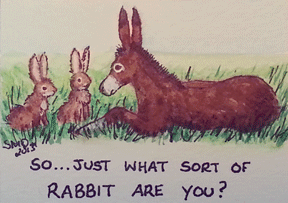
rabbit-are-you-aceo

Sometimes you just need to know how to begin!

I had a great conversation tonight with a friend who is seriously considering raising rabbits. We went around and around about what type of rabbits he should get, what supplies he needed before his initial purchase, what his rabbitry goals would be. The reality is that we can’t answer any of these questions for him – he needs to spend time thinking about what will be the best fit for his purposes. However, we can ask him some questions to get his creative juices going… here are the few he left tonight pondering:


1. How many? The number of rabbits you choose as an initial investment depends on your purposes for your rabbitry. If you are looking to show, you’ll likely want to consider three does and two bucks per breed. You’ll want some options for genetic strength, plus it’s not as much fun to take a single rabbit to a show. Set yourself up for success by giving yourself some options.

If you are specifically breeding for meat, a trio of two does and a buck will be a strong start, even closely related rabbits would be fine to start as long as you have a plan for infusing new blood sometime in the next year or so. Ask yourself how often you’re hoping to have rabbit on the menu? How many mouths are you feeding?


2. What’s your Budget? Your purposes for your rabbitry must inform your anticipated budget.

Are you planning to keep rabbits only for your own consumption? Then an unpedigreed meat mutt might be a good start as they are typically as much as 50% cheaper in initial investment. The downside to an unpedigreed rabbit is you don’t have an idea of the size or colors in the background of the rabbit – of course, if your main goal is for meat… those are considerations that really don’t matter! In this area meat rabbits are sold for around $25 per rabbit (I’ve heard people quote a range from $5 to $35 for a meat mutt around the country).

Are you hoping to sell the babies of your rabbits to offset other rabbitry expenses? Then you’d better be willing to spend a little more for a pedigreed rabbit as your initial purpose – a registered rabbit is even better if you can find one. The pedigreed rabbits I’ve seen advertised are anywhere from $45 to $150+ per rabbit, depending on your lines, the show worthiness, proven or unproven, registered, etc.

Obviously, with that much of a price range, it makes sense to consider your intended outcomes before you make your first stock purchases. I will suggest to purchase the best quality rabbit you can find in your price range. Don’t go simply off of slick websites or advertisements, instead contact several breeders and ask for recommendations.

Facebook is a good way to connect with other rabbit breeders, although be cautious – sometimes the people who post the most and sound the most knowledgable are the same ones you should avoid at all costs. Particularly on Facebook, once you’re in the group for your rabbit breed, spend time reading through the archives of comments and posts. Over time you’ll get a sense of those breeders who have a similar value system to your own… contact them and see what can come from that!


3. What will you Feed? Are you planning on feeding your rabbits pellets or letting them range and eat grasses? A smart buyer will purchase their initial stock from a breeder who is set up similar to what they want to do.

We feed pellets and hay and can give someone a pretty good idea of what weights to expect at which ages in our lines. However, if someone took our rabbit and switched it on to a fodder system I can almost guarantee it would not hit the same weight gains in the same period of time. If someone approaches us wanting meat rabbits for fodder I’m going to encourage them to check in with a few other breeders as our rabbits will likely not perform as well for them. (The caveat to this is that it only takes a few generations of careful culling to transition a rabbit from the desired growth rates on fodder. So the question is how long you’re willing to wait!)


4. Where will they be Housed? Similar to the advice on feed, consider whether the rabbits will have a similar environment to what they have been used to when they come to your home. Our rabbits are outdoors 100% of the time – and they don’t all transition with excellence to an indoor garage rabbitry! On the other hand, we’ve purchased rabbits coming from a garage rabbitry and there’s been a significant adjustment season for them to enjoy life in their new outdoor space with a view!

On the same lines, consider temperatures. A rabbit used to Phoenix temperatures will likely not fare very well in, say, Minnesota if it goes to it’s new home in January! Try to either purchase your stock from a rabbitry in a similar climate to your own or in a “shoulder season” so the rabbit has time to transition to the new season with as little stress as possible.


5. What breed? Do you want a 13+ lbs Flemish Giant rabbit? Is a mini Satin going to be just the right fit on your lap for a snuggle? When you look at your rabbitry, which rabbit is going to take your breath away just by looking at it? Start browsing photos of the different rabbit breeds. Educate yourself on the pros and cons of each breed – they all have both!

Ask yourself again what your goals are for your rabbitry, and what gives you joy. There is a great deal of poop cleaning, water bottle scrubbing, consistent feeding, etc. necessary to care for your rabbit – so whatever you do, get a breed you enjoy watching move! Learn about their personalities and make an educated decision. Genuine pleasure in being around the animal makes the endless hours of husbandry less daunting.


6. What breeder? Do you want a simple transactional purchase of livestock? Do you want to develop a relationship with a breeder? Do you want someone you can contact months after the sale and ask questions about raising your animals? What is the breeder’s philosophy about rabbit raising? Take your time in selecting a breeder.

Some people will be attractive to you right off the bat and you just know they’re the right fit for your first rabbit purchase. Others are the exact opposite and you’ll know you don’t want to work with them right away. Occasionally you’ll work with someone you don’t particularly like because you’re terribly interested in their specific stock!

Challenge yourself to think through some of these questions as you start your search so that you’ll recognize a good fit for a breeder quickly.


Finally,

Relax! Regardless of anything else, relax! It’s a rabbit! We’re over the top crazy about these little critters, but they still are just that… critters! There is not a thing in this hobby/lifestyle that can’t be adjusted or fixed, so try not to freak yourself out with all the options. Just relax, have fun, and be intentional about your rabbitry!

Newest Rare Breeds List Released!

20140706-100603-36363433.jpg

We are pleased to be raising the #1 rare breed in the U.S.! Glad to be doing our part to keep Blanc de Hotot going!

Every three years a “rare breed” list is released. We’ve been raising three of the 15 rare breeds until now… And with the release of this list we now have two! Cinnamon and Silver Fox are making a come back!

What is the Rare Breeds List?
Here is the short version
#1 is most rare, #16 is less rare

2014 Rare Breed Rabbit Rank
(with 2010 rank on right)
1 Blanc de Hotot (1)
2 Giant Angora (2)
3 American (5)
4 Beveren (4)
5 Giant Chinchilla (7)
6 Creme d’Argent (14)
7 Belgian Hare (11)
8 American Sable (10)
9 Satin Angora (6)
10 Cinnamon (3)
11 Lilac (8)
12 Silver (9)
13 American Chinchilla (12)
14 Palomino (16)
15 Standard Chinchilla
16 Rhinelander (15)

Note: Silver Fox was #15, is now #17 and is off the list, but remains as a Watch status. Standard Chinchilla has joined the Rare Breed List as #15


Patriotic Rabbits: The “New” White Meat

patriotic bunny

Truthfully, I feel sorry for this rabbit. Bunnies in costumes scare me a little.

I just finished reading an article on rabbit, the “new” white meat. (What’s up, Chef? Rabbit is the Trendy New White Meat)


While I’m not thrilled to be associated with “trendy” things, it is validating to see other people recognizing the benefits of rabbit meat because there’s really not another meat that can compete with rabbit for nutrition. It’s low in fat, high in protein, flavorful, and has a higher meat/food conversion rate than just about any animal out there. Add that to the ability to raise rabbits in your backyard quietly and I’m pretty sure rabbits are the perfect urban livestock!


Over the time we’ve been raising rabbits we’ve had a chance to get several others started on their urban homestead. I am so appreciative of these new friends who are drawn to a desire to know what is in the food they consume and who want their children to realize meat doesn’t initially come on a styrofoam plate. While rabbit raising isn’t for everyone, I truly believe it’s an approachable way to begin to take back control over your food sources.


Rabbit rearing gained popularity during World War II when most beef was reserved for the military forces. It lagged  as a livestock in the intervening years, but many say it’s at all time highs once more as Americans become more concerned about the additives in bulk produced food.


Coming up on Independence Day, who doesn’t want to celebrate self-sufficiency?! 🙂

Turn! Turn! Turn! (To Every Rabbit there is a Season)

Airborn Raptors

Airborn Raptors

Not to get all preachy, but around here we are big believers than everything has a purpose for it’s being. If we have a tool, it should be used for the purpose it was created to fulfill to the best of its ability. If it’s a human, we believe we are called to a high ethical standard and put our hands to good work. For our rabbits, we believe they honor their existence by fulfilling a purpose whether it be fur, fancy, or food.


I love reading these words, memorialized in the Bible long before that fantastic musical group the Beatles:

There’s an opportune time to do things, a right time for everything on the earth:

A right time for birth and another for death,
A right time to plant and another to reap,
A right time to kill and another to heal,
A right time to destroy and another to construct,
A right time to cry and another to laugh,
A right time to lament and another to cheer,
A right time to make love and another to abstain,
A right time to embrace and another to part,
A right time to search and another to count your losses,
A right time to hold on and another to let go,
A right time to rip out and another to mend,
A right time to shut up and another to speak up,
A right time to love and another to hate,
A right time to wage war and another to make peace.

But in the end, does it really make a difference what anyone does? I’ve had a good look at what God has given us to do—busywork, mostly. True, God made everything beautiful in itself and in its time—but he’s left us in the dark, so we can never know what God is up to, whether he’s coming or going. I’ve decided that there’s nothing better to do than go ahead and have a good time and get the most we can out of life. That’s it—eat, drink, and make the most of your job. It’s God’s gift. (Ecclesiastes 3: 1-13)

It’s not often I get all philosophical on this website, but today we made a significant decision for us — we donated several rabbits to our local Raptor Rescue.

Our main focus in raising rabbits is providing an organic meat source for our family. However, there are times when we just have more rabbits than we can personally use. Not every rabbit is destined for the show table, and it’s not ethical to sell a pedigreed rabbit as a show rabbit simply because it’s purebred, even though the sale of pedigreed rabbits recoup food costs.

We were turned on to our local Airborn Raptors Unlimited rescue by another family involved in our 4H club and we have been so impressed with Alyssa and her program. They have been doing free shows with the raptors for many years and do their best to treat their animals extremely well.

Birds of prey eat. They eat prey. The number one prey animal in the world is the rabbit! (That’s why they have so stinkin’ many babies!)

So when we found ourselves in a spot where we had more rabbits than we could use for the time being, we contacted Alyssa. Since they run their program almost entirely on donations, she was incredibly grateful. We learned an interesting fact as well, our domesticate rabbits are significantly larger than wild rabbits; cottontails and jackrabbits and such. Out little 5 pound fryers can feed three raptors and a fully grown commercial breed rabbit (8+ lbs.) can feed at least five birds. That’s pretty amazing production and food usage!

It’s a hard decision for us to let any animal go, but it does feel like each of our rabbits has a distinct purpose in their life and that’s also something beautiful. I know that our rabbits will go to further a worthy cause and nourish a beautiful animal, although it’s difficult to imagine them going at all.

Creating an Emergency Manual for Your Rabbitry

As I write there is a wildfire raging less than 20 miles away from home with a current 0% containment. It has exhibited extreme fire behavior and consumed more than 4500 acres of land in just over 24 hours. Our friends who live closer to the fire area are on pre-evacuation and, while I really suspect we will not see any danger at our home, we are carefully considering what measures we will take if we need to evacuate the area ourselves.

Too many times I prefer to sit in la-la land, assuming the best of everyone and believing that nothing out of the ordinary will ever happen. However, as so many of us know, this is simply not the reality. Life is unexpected because, well, life is unexpected!

Not long ago a magician made news when the USDA forced him to submit an emergency plan for the rabbit he used to pull out of his hat while performing. The rule was from the agency’s Animal and Plant Health Inspection Service (APHIS):

“APHIS published a final rule requiring all dealers, exhibitors, intermediate handlers, carriers, research facilities and other entities regulated by the Agency under the Animal Welfare Act (AWA) to take additional steps to be better prepared for potential disaster situations.  They are required to develop a plan for how they are going to respond to and recover from emergencies most likely to happen to their facility, as well as train their employees on those plans.”

Admittedly, this seems like overkill in the case of a magician and his single rabbit, but the reality is it’s good business and solid animal husbandry. Many of us depend on these animals to provide for our family’s protein. They are defenseless without daily care taking – and if we want to be ethical (who doesn’t?!) we really must give some thought to how we could best care for these animals should the worst occur.

A rabbitry management book is a useful tool in case of emergency, someone taking over the care of your rabbitry while you vacation, or to produce as proof that you really are doing your best to provide the very best care possible for the animals under your management.   The USDA actually outlines what your rabbitry risk management manual should include. (These guidelines generated a 34-page report for Marty the Magician and his bunny that is really worth the read.) Your emergency plan should:

  • Identify types of emergencies seen frequently in your region
  • Identify emergencies that could occur at your particular type of facility
  • Identify specific tasks that facility staff will undertake in an emergency situation
  • Establish a clear chain of command for all employees to follow
  • Identify materials and resources that are available to your facility and elsewhere, and
  • Ensure all pertinent employees are trained on this plan

The guidelines further explain that “the terms ’emergency’ and ‘disaster’ are not limited to major natural disasters, such as hurricanes, and should include consideration of localized events such as a fire, severe weather, or any other unexpected situation that interrupts normal animal care activities.”

Truthfully, while the bureaucracy is intimidating (and overkill), it’s also really useful to take a look at these guidelines to see where the holes may be in your own rabbitry emergency response manual. I’ve had many of these ideas floating around in my head off and on, but I’ve never committed them to paper and communicated with my family about the plan for the rabbits in case of emergency.

While the guidelines consider many different types of emergencies such as structural fire, electrical outages, disruption in feed or water supply, road closures, intentional attack on facility/personnel, unexpected change in ownership (or death of owner), HVAC malfunctions, animal escape, animal disease outbreak, as well as other natural disaster scenarios. Specifically, for evacuation, the APHIS guidelines point out the need for a plan for:

  • Transportation vehicles and equipment/caging. Do you have carriers for every animal you have on site? Once filled, do you have a vehicle that can fit and transport all of those carriers to safety?
  • Alternate location for housing animals. Where are you going to take your furry friends where they will be welcome? Most Red Cross shelters are open to humans, not animals!
  • Husbandry and care needs for the animals during transport and once animals are relocated. Do you need nest boxes? Do your carriers each have a water and food bottle? Do you have enough food on hand to send it with the animals and expect it to last until the emergency is resolved? Are there significant temperature or climate differences between your home and the relation spot that need to be considered?
  • Animal Identification. Are all your animals tattooed in a timely manner all the time? Do you have a list of which tattoo number belongs to whom out of the danger of the disaster?
  • Records Transfer. Do you have electronic back ups of your pedigree programs? Breeding records? How about a paper copy of registrations and Grand Champion certificates, as well as Bills of Sale?  Are these stored in a location that would be unaffected by your disaster?

A few other thoughts that have crossed my mind as we consider the logistics of possibly moving our animals:

  • Actually practice the plan. Nothing on paper is committed to memory unless it is practiced.
  • In an emergency situation, a bale of hay can go a long way for a lot of rabbits! Having a bale on hand at all times provides a distinct level of comfort.
  • Identify — in advance — which animals can be quickly culled and which are essential for the survival of the breeding program. Write it down and consider identifying their cages with a mark so anyone helping with the evacuation will know where to focus their energies.
  • What is available for nursing mamas and their babies for transport? Possibly laundry baskets, banana boxes, or larger pet carriers are a possibility.
  • How many bags of feed do you use a week/month? Do you have a 30 day supply as a general practice?
  • Consider the ethics of releasing domesticated animals to fend for themselves in an emergency. Obviously, the priority in any situation must be the humans… but to expect natural survival instincts to kick in for a rabbit that has been bred to be dependent upon humans for decades is irrational. Their care must be a priority in the same way a human baby should be protected in a disaster.
  • Do you have a “go bag” of  rabbit first aid packed with items like gauze, Neosporin, critical care, electrolytes, nail clippers, Vetricyn, etc. Where is your tattoo kit?
  • Where is your plan kept? Is is handy where you can grab it and skim if your mind is stressed and you’re worried about other things? Could you hand your plan to a helper and feel confident they would understand your methods and wishes from what’s written down?
  • What about copies? I have my pedigree program on my computer – but if my computer is damaged I’m in trouble! I also have a notebook binder with rabbitry information. This needs to be copied and sent to a safe place completely separate from my zip code in case the binder burns or is damaged through water or wind attacks.

I hope this post isn’t the world’s biggest downer! I’m a big believer that if you see 10 problems coming down the road at you, 9 will fall into the ditch before they ever meet you. BUT — there’s always that one… and Murphy’s Law!

Can You Feel The Love Tonight?

ilco / stock.xchng

ilco / stock.xchng

As silly as it may seem, sometimes rabbits don’t… breed like rabbits.

I often hear complaints about a doe that won’t lift or is otherwise reluctant to breed. This is not necessarily uncommon and can be a factor of age, weather, or general temperament. Most often a buck is more than willing to oblige but occasionally you run into troubles with your mister refusing to be a “kisser.”

There are some fairly standard recommendations for getting your rabbits “in the mood”:

  • Add Apple Cider Vinegar to their water or wheat germ to their feed;
  • Make sure they have at least 16 hours of daylight each day;
  • Put the doe and the buck in one another’s cages for 24 hours;
  • Table breeding;
  • Breeding by moon calendar.

But just this month we came across a totally new (to us) method – breeding by moonlight.

Since rabbits are fairly nocturnal it’s not a surprise that they are more active at night. In warm weather we sometimes sleep with our windows open and the noise the rabbits make playing with their toys and thumping around can be quite noticeable. (They’re no match for an antsy barking dog or a cat in heat, but for a rabbit they’re loud!)

Rabbits are lively at night!

Just this month we got home late and remembered that we needed to breed a few rabbits in order to plan their due dates around some travel plans next month. So, even though it was fully dark, we decided to head out to the rabbitry and see if we could get some dirty business started.


Oh. My. Goodness.

What a shock! Those girls were so ready it was as though their backsides were attached to rockets! We had such immediate success by moonlight fraternization we even attempted to breed a few of our most reluctant ladies — and they were quite happy to oblige!


This was such a blatant change of pace that it’s another trick we’ll be adding to the options for what to do when your doe isn’t interested. After all, everybody loves a little late night romance, right?!


*We will continue to use the moon calendar for our breeding programs. Here’s the link to a 2014 moon breeding calendar!*