Category Archives: Meat Rabbits

If Worst Comes to Worst: The Second Buck Insurance Policy

Blue Silver Fox

Blue Silver Fox

On the theme of starter stock and how to best begin your rabbitry in our previous post, How Do You Find Starter Stock?, I wanted to share some advice I saw an experienced breeder give recently.


This breeder recommended buying two pair of rabbits, a quad, when beginning your rabbitry. Most experts will suggest buy just a trio, two does and a buck. If you’re in an area where it’s easy to find your breed that is perfectly sound advice as one buck is certainly able to service two does without a single problem.


However, if you’re looking at a hard-to-find or rare breed, or you’ll have to transport the rabbits a good distance to get them home, you might strongly consider purchasing a quad. This helps insure your investment is anything goes wrong (because we all know Murphy and his stinkin’ Law!).


For example, what if something incapacitates just one of your rabbits… but it’s the buck? What will you breed to your does for babies? In the “what if” possibilities that buck becomes pretty important and have another boy around might not be so bad!


I had never considered this prior to reading his advice, but now think it’s a pretty smart plan. That second buck is like purchasing insurance – possibly never necessary or utilized but terribly, terribly important if worst comes to worst.


How Do You Find Starter Stock?

Asking the right questions is the first step to locating great foundation stock.

Asking the right questions is the first step to locating great foundation stock.

I loved this post over at Rabbit Ranching and got permission from Ms. Cahill to reprint it on Mad Hatter Rabbits. If everyone who contacted us for rabbits followed this advice it would be so awesome! (I have added a few thoughts at the end.)

Q&A Session #2 from Rabbit Ranching by JuliCahill

This is the first part of an ongoing series allowing readers to ask questions about the rabbit hobby. There are no rules or guidelines. Have a question? Ask away! Post your question as a comment on our blog or email oakridgerabbits@gmail.com.

Readers are encouraged to share their own ideas or opinions in the comments below.

What questions should you ask a breeder when choosing “show” foundation stock?

Ah, the age-old question. When you’re starting out with rabbits or starting a new breed, your foundation stock will ideally carry you through the first generations of creating your own line. But it’s easy to get burned by lesser quality animals or fake pedigrees if you’re not sure how to search wisely.

The best place to start is ARBA’s recognized breed page, which can be found HERE.

From this page, you can click on the photo of any currently recognized breed, and it will take you directly to the breed’s specialty club. To my knowledge, every (or at least most) breed clubs post sweepstakes standings on their website. Sweepstakes is a contest based on show wins, and only club members are eligible. Look to see who is at the top of the list and keep those names in mind.

Next, visit the registered breeder directory, which should also be available within the breed club website. Keep in mind that this will only list contact information for breeders who are currently members of their specialty club. ARBA has a more general breeder directory on their website. If you don’t find the name you’re looking for on one, check the other.

I would choose about five names of people local to you (or within the distance you’re willing to travel). There is usually an email or phone number listed for contact.

Now…what to ask? …

How should a newbie, who wants to show their favorite breed, approach a show breeder to purchase stock?

Tell them them exactly what your goals are:

Example: “I want to show and raise Holland Lops.”
Example: “I am looking for two Satins to keep as pets and show locally.”
Example: “I want a pet Dutch.”

The breeder needs to know exactly and directly what you want the rabbits for. If you just email asking, “Could you send me a list of rabbits for sale?” you’ll probably find few who take the time to respond. Everyone has rabbits for sale at some point in time, but they need to know exactly what you’re interested in.

Other information to include:

– The number of rabbits you’re interested in buying.
– The time frame in which you’re looking to buy.
– Your location.

Example: “I would like to start with one buck and two does. I am hoping to find my starting stock this spring, and I’m located in Dallas, TX.”
Example: “I want to find two bucks and three does before September. I’m located in Trenton, NJ.”

This is all of the information specifically needed to get you started, and I recommend leaving the rest up to the breeder. If they have other questions, they will ask. Mentioning other specifics (wild, unusual colors being a common one) not only narrows your search, but also makes most serious breeders question your intentions.

Instead, ask the breeder whether they have rabbits available that meet your criteria. If you are unsure of which color, group, or variety is strongest and most developed – just ask! This is what you will want to start with, and an experienced breeder can guide you directly to it.

So, how do you know you’re speaking with someone reputable?

Ask everyone within your original inquiry – “I am new to this breed. What lines do you recommend working with?”

This is the golden question because it will reveal the authority in the breed of your choice. Like it or not, the success of every breed is strongly influenced by a handful of very dedicated, very successful breeders. They are the names you’ll see over and over again on pedigrees all over the nation. If you ask five breeders this question, you are likely to find out quickly which lines are “go to” in the breed.

If you can (whether they are local or whether you have to arrange transport from a national convention), try to purchase stock directly from those people. If you can’t, try to find someone who has used their rabbits to build their herd.

A name doesn’t mean everything, but it does mean a lot. A reputation is something that’s built by word-of-mouth and personal experience. If people, in significant numbers, speak highly of someone in particular, they are likely to be a trustworthy source. If it’s someone no one has heard of or mentions without prompting, it’s generally not a good starting place.

I could talk more about this topic, but I think I’ll save that for another day. This is where I recommend starting. From there, many reputable breeders will be interested in helping you learn more.


A few thoughts from Mad Hatter:

I completely agree about the recommendation to follow breed sweepstakes… and I don’t. We have six different breeds here and are members of the national clubs of only three. Some national clubs have far too many politics for us to want to get too involved right now… or it just isn’t the right time for us to have many memberships… what not. So, while I believe sweepstakes points are one factor in determining a reputable breeder, I would consider it with other knowledge as well.

Another research option is to check the Domestic Rabbits publication from ARBA for those owners who have Grand Champion rabbits in their breeds.

Being completely clear about your intentions is important! For us, since we raise mostly dual meat/show rabbits this is especially significant around here. If you tell us you are going to show rabbits we will set you up with the best-typed rabbit we can. If you tell us your entire purpose is for meat we won’t put as much emphasis on show promise as your desired outcomes will likely have more to do with production, making weight by a specific age, and mothering abilities than the length of shoulders or whether their body is conformed to the Standard of Perfection!
Entertaining your Rabbit

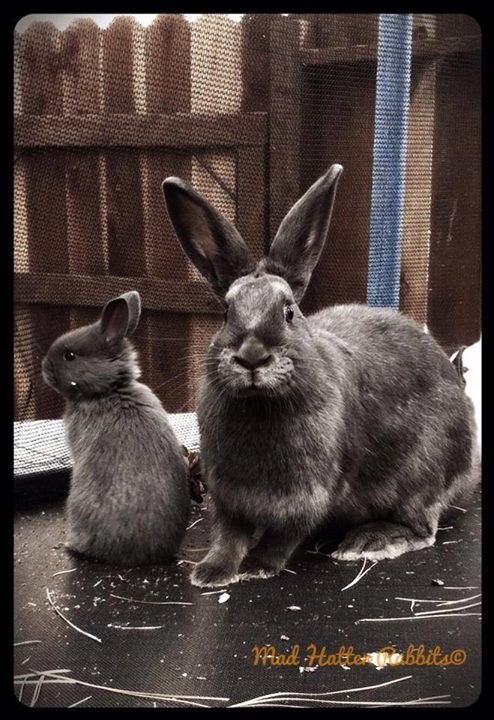
Canning lids are a favorite toy around here.

Canning lids are a favorite toy around here.

Many rabbit owners give their rabbits toys to play with – but it’s not necessary to spend tons of money on toys to keep your rabbit entertained.


Rabbits will play with anything from wiffle balls to golf balls and bells but are equally happy with bits of untreated 2×4 or sheet rock that doubles as a resting board. Natural options include apple wood and willow tree twigs, and pine cones. Baby teething toys like plastic key sets or evenshower curtain rings provide satisfactory noises when thrown around their home.


Toilet paper tubes, empty tissue boxes stuffed with hay, empty oatmeal containers, or boxes give rabbits lots of entertainment.


We’ve recently discovered the metal rings for canning jars are great toys for the rabbits. They’re metal and clang when tossed, plus we can put them in the dishwasher to sanitize and clean them up without ruining them!


IMG_4495


What do you give your rabbits as toys?


How To Tell Your Kids What’s For Dinner

Meat processing may not be the oldest activity in creation, but it's close!

Meat processing may not be the oldest activity in creation, but it’s close!

When we began raising rabbits it was to provide an organic meat source for our family. We did a lot of research and discovered rabbit meat is one of the healthiest meats around, rabbits are easy to raise and relatively inexpensive, and they are quiet, making them an ideal choice for our vaguely-urban neighborhood.


Even though it was a logical choice for us, the reality of having children is that what makes sense to an adult is not always sensible to a young one! Many people have asked us how our children react to knowing we’re having rabbit for dinner so this seems like a good place to address their questions.


Our major philosophy with butchering (and life!) is to be honest with our kids, answer any questions they have, invite them to participate as much as they would like (but never force them!), and to share our reasoning and the struggles we have with the process.


Make no mistake, taking life in any form is significant to us and not something we do lightly. I’m been known to apologize to an apple tree for picking an apple! (Yep, I know this is strange but it’s how I roll!) Knowing we have a reasoning and thought process behind it makes a huge difference for us.


I’ve found this article (Kids and Farming: How To Tell Your Children Which Animal Is For Dinner) has some great tips on preparing your children for livestock processing. They do a good job of giving pointers on how to work with your children through what some might consider a disturbing event.


Our children have had lots of question but in general are really unconcerned about eating animals we’ve raised. When I announce we’re having rabbit enchurittos for dinner, rejoicing is heard throughout the land! Ha!


Every child is different and each family needs to find their own comfort level, but here are a few things that have worked for our children as we discuss raising rabbits as livestock rather than pets:


1. Every rabbit has a purpose. We watched a movie called Hugo a while ago and I fell in love with the main premise behind the film: that everything is created to fulfill a purpose and bringing that purpose to fruition is a thing of beauty! On a basic, biological level, rabbits were created as food for others. This is why they reproduce so quickly, have such short gestation periods, and are relatively unintelligent, small, and nutritious. Though they can fulfill multiple purposes, perhaps as a breeding animal for stunning show stock or as a companion for a human, at their basic level they are prey. Allowing them to complete their function is a thing of beauty in the same way humans can fill different roles, perhaps as a mother, or lawyer, doctor, or garbage collector. Every thing has a role to play!


2. Rabbits are an object lesson. We encourage our children to a part of the harvesting process much as they would like. While processing we use our rabbits as hands-on learning; we take care to identify the different elements of anatomy, recognize what healthy animals look like or what we might see if an animal were sick; we talk with our kids about the food we feed the rabbits and why protein content in a pellet matters, about how access to hay enhances a rabbit’s life, and what methods of taking life are honorable, fast, and painless. There are so very many subjects that come up from an educational standpoint if you talk honestly with your kids about your motives and how every piece of this life puzzle fits together, plus this provides a fall back plan for them in the event of a major lifestyle change. Has anyone seen Hunger Games?!


3. Our meat shouldn’t come on a styrofoam container. While grocery stores are convenient and I visit one (or two!) on a weekly basis, we want our children to understand that milk doesn’t come in plastic jugs and meat isn’t naturally served up on a styrofoam container. Most people in the U.S. are one-to-two generations removed from a food-producing farm and we’ve forgotten that we are dependent upon nature and hard work to provide the food we need to survive. As parents, we talk with our children about farming and our commitment to providing for our own needs in as wholesome and healthy way as we have available.


4. We adopt an attitude of gratitude. We have willingly entered into a symbiotic relationship with our livestock. It is our responsibility to care for the rabbits in the best way we know how and we take our stewardship very seriously. We always talk with our children about how thankful we are that these rabbits are able to meet one of our foundational needs — to eat — and do not take the responsibility we have to the animals lightly.


5. Practical Anonymity. When it’s all said and done, no matter how much you talk to someone about the big picture and philosophy behind raising your own food, no one wants to know it’s Mr. Binkles on the dinner plate! From a practical standpoint, we won’t name rabbits unless we intend to keep them for a good while and we typically process and freeze the meat under the generic “rabbit” term for long enough that we can’t remember who was whom!


While this is a far from exhaustive list, I hope it provides a spring board for your own discussions with kiddos about livestock and food and our roles as consumers in this world.


If you can’t keep it in your pants… at least keep it in the family.

Occasionally there's just something a little... off... about a pairing.

Occasionally there’s just something a little… off… about a pairing.

We went to several family reunions this summer and, truth be told, our 5-year-old daughter developed a bit of a crush on one of her cousins.

I overheard the 7-year-old talking to her about this crush: “You can’t marry him! He’s our cousin! If you get married your kids will have two heads and three eyes!”

Yep. We’ve talked about the dangers of inbreeding our family. As a practice for human beings we are 100% against it.

But rabbits are a different story.

When you’re thinking about how to get the healthiest herd with the least amount of animals, there’s no doubt you have to consider how closely related you want your rabbits to be over the long haul.

We have worked pretty hard to get unrelated animals to start our herd, importing bloodlines from all over the United States. That being said, we’re planning on sticking with these animals and their offspring until we have a very solid “Mad Hatter Rabbit” stamp on any animal that comes from our barn.

The Domestic Rabbits publication by ARBA had a great article about the differences between inbreeding (breeding siblings) and line breeding (breeding father/daughter, mother/son, grandparent/grandchild, etc.). Most of the top breeders utilize line breeding regularly to “stamp in” the breed characteristics they find most desirable.  Additionally, traditional wisdom says if you get a brother/sister pair, produce one mating out of that pair (inbreed) and from that point forward switch to line breeding and you won’t run into problems.

I spoke with a friend who is a geneticist and his experience confirms this philosophy. He told me in scientific studies researchers have deliberately inbred their rabbits, trying to get the most genetically similar test subjects possible. It was only after 18+ generations the researchers began to see problems like malocclusion (wolf teeth), compromised immune systems (sickly rabbits), and other common problems associated with inbreeding.

We have personally bred a brother/sister combination of rabbits that we knew nothing of the genetic history about. The litter produced wolf teeth and poor immunity and we ended up culling it from the breeding program and vowing to never repeat that breeding. But remember – we didn’t have a pedigree on that pair and have no idea how many times their ancestors were inbred before they got to us!

This is another reason it makes sense to spring for a pedigreed rabbit when purchasing stock. In one case we found rabbits from different states but after looking over the pedigrees I discovered the rabbit was related identically to our other rabbit after two generations back! We were able to make an informed decision about whether we wanted that rabbit in our herd.

Typically line breeding makes the good stuff you’re seeing in your rabbit better and the bad stuff worse. It’s like getting a double stuff Oreo – augmenting the genetic qualities with potentially awesome or disastrous results.

Here’s a graphic that might make the idea of line breeding a bit more understandable:

line breeding / inbreeding / outcrossing chart

line breeding / inbreeding / outcrossing chart

Ultimately every breeder must make the decision they feel is best for their herd regarding how tightly they breed their rabbits. We do practice line breeding with moderation and willingness to cull hard if a poor pairing appears. With our Astrex program we must do tight breeding to a certain extent to try to isolate and reinforce the curly gene – while always keeping the health of the rabbit in mind.

Fascinating stuff, huh?!

Blanc de Hotot!

20130820-193027.jpg

We are so excited to welcome Blanc de Hotot to our Rabbitry!

Our friend, Lisa, of Trinity Hallow, lured us into the breed by exposing us to some beautiful rabbits. Then my mom decided she likes Hotot (pronounced oh-toe) and my kids started begging for “mascara bunnies” and we ended up with the number one rare breed in the U.S. camped out in our back yard!

We alternate between calling these guys “mascara bunnies” and “rock stars” but there’s no doubt they have explosive personalities and a certain je ne sais quoi about them. (I start using French phrases when talking about French bunnies. He he!)

It will be a few months before we have any Hotot babies and it will be a new challenge to get show marked rabbits without any random black spots (Blancs are genetically black rabbits with a Big White Spot), but we’re looking forward to the experience!

Snuffles, the Rabbit Boogie Man

For the past two months I’ve had an over-riding fear in my gut about our rabbitry. I’ve been gobbling up knowledge on the Facebook rabbit groups, researching, and gaining information from my friends… I’ve been on high alert and on edge, ready to jump at the first sneeze from one of our rabbits.

Snuffles. What on earth is Snuffles and why is it so awful?!

Snuffles is a term for a rabbit virus called Pasteurellosis. It’s associated with colored snot and is the herald of death for a rabbit.

I recently learned that another rabbitry blog I follow is in the midst of a Pasteurellosis outbreak and has lost 75% of the rabbits in only days. He linked to a thread on RabbitTalk that covers how another rabbitry lost every rabbit in their herd over the course of three months after picking up one unknown bunny from the feed store and bringing it home. On one of my Facebook threads I’ve learned that rabbits brought to a national-level show were infected with the virus and sneezing. The rabbits exposed to those have returned to their homes all over the country and come down with snotting and sickness.

This stuff is serious. That’s Serious with a Capitol “S”.

My friend Lisa put together a great description of Snuffles and how and why it is so deadly to a rabbit. She said I could quote her here, so I will!

“Pasteurellosis is like an untreatable plague that can be prevented through culling and quarantine but it cannot be defeated or treated. All rabbits are carriers, normally. They show no symptoms because their body has kept the virus in check.

But a virus overload can happen when they are around other rabbits sick with snuffles because the virus overloads their system to the point where they can’t fight it … it’s like the parasite load gets to be too much and kills its host.

Think of it like an airborne bunny HIV or AIDs – it weakens the immune system to the point that any other virus that comes along – boom! – they’re dead. And because it’s so contagious you will definitely lose your herd if you don’t cull at the first sign of snot. Think of it like a smoker that constantly coughs and can’t breathe – the virus makes it so that the cilia that line their lungs become so damaged that little particles of dust, etc. can get lodged and cause major damage.

Rabbits have never shown a resistance to pasteurellosis so it doesn’t make sense to let snuffles “run its course” in hope of creating a rabbit with immunity. It’s in an area of the nose that doesn’t have much access to blood so it will propagate and continue to develop and be released into the blood stream.”

What makes this harder to get a handle on is that the Pasteurellosis infection is carried in pretty much all rabbits and is seen in practically all large-scale rabbitries and most of the smaller ones. It’s present in laboratories and wherever rabbits tend to congregate.

Here are a few things researchers have discovered about Pasteurella:

  • Snuffles does not usually occur in very young animals whose sinuses have not yet developed.
  • Snuffles is seen more in closed sheds than in hutches in the open air.
  • Affected rabbits sneeze and cough. Their front paws become matted from wiping their noses.
  • Snuffles will become apparent at times of stress such as travel, cage change, pregnancy, etc.
  • The most common cause of death for a rabbit with Snuffles is actually pneumonia.
  • Snuffles is extremely contagious and can be transferred via sneezes, on cage equipment, or even on food dishes, water bottles, or the clothing of the herd caretakers.
  • Traditionally a terminal cull is the only option to stop an outbreak.

There is a treatment for rabbits, Baytril, which can mask the symptoms of Snuffles for awhile in a rabbit, but it looks like two injections a day and a price tag of approximately $75/month. It’s only available with a prescription and only recommended for pet homes where no one will be coming in contact with other rabbits.

A brand-new option is the Bunny Vac. I actually have ours on order and will vaccinate as soon as it comes. We are against putting medicines into our rabbits, but after weighing the options and our desire to take our rabbits to shows, it makes sense to vaccinate our herd. The BunnyVac works to boost the rabbit’s natural immunity and give the rabbits more time to build up their antibodies so they can fight the infection themselves. It’s rather groundbreaking and we hope that it works as promised – clinical trials have had 100% effectiveness in rabbits exposed to Pasteurella not succumbing shortly after. Here is a video with more information and here is a fact sheet put together off of a discussion on the ARBA Facebook page.

Here is a link to an article talking about different rabbit respiratory diseases. Not every sneeze and snot is Pasteurella – but really nothing that is a sneeze or a snot is good news for your rabbit.

A few things you can do to avoid a Snuffles outbreak in your herd:

  • Keep your rabbitry clean. A build up of ammonia from urine and feces can and will irritate your rabbit’s lungs, making them vulnerable to Pasteurelliosis.
  • Quarantine any new rabbits. Keep new rabbits separated from your main herd for a minimum of six weeks (this gives the virus time to make itself known if it is present). Rabbits should be a minimum of three feet from any other rabbits, have a barrier put up between cages (as simple as a feed bag), and be fed and watered with different utensils than the regular herd.
  • Close your rabbitry. Do not allow any people, other rabbits, or possible contaminates into your rabbitry. Do not offer stud service. Produce your own stock or only acquire stock from rabbitries you know breed healthy rabbits with strong immune systems.
  • Terminally cull any rabbit who sneezes colored snot. There is a chance they could be reacting to an allergen or have something stuck in their nose. If you think this is a possibility, isolate the rabbit that sneezed, remove the possible allergens from its environment, and watch it for a minimum of six weeks. If it snots in the meantime, do not give it the benefit of the doubt.

These are pretty hard bits of advice, but this is a harsh disease that can wipe out a herd in a matter of weeks. Sacrificing one rabbit with quick action has the potential to save many other rabbits for the long term.

Bad Timing

Rabbits! There are so many rabbits!

Rabbits! There are so many rabbits!

It’s been a busy weekend for us – three does from three different breeds gave birth! Our Champagne d’Argent, Silver Bell, Silver Fox, Ceres, and Silver Marten, Bonfire, all had large, healthy litters and we’re still waiting on one more mama to pop any time.


That’s a wonderful place to be because getting stock that produces and raises what they bear is quite nice and all of these does are proven and have our trust. They don’t typically lose any babies. Having all of this happen at once is also a bit scary because the size of our rabbitry doubled in a day! Whew! We’ll have babies for sale soon!


Silver Bell threw us a curve ball this time, however, and I thought it would be worth writing about as our friend Primrose the Holland Lop did something similar a few weeks ago.


While I was feeding and watering the rabbits yesterday morning I noticed Silver Bell looked… distressed. We had given her a hard time because she had taken all of the hay out of her nest box and put it in the corner of her cage on the wire. We called her crazy and put the hay back in the nest box, and she began to gather it in her mouth and start to move it out again. We decided to let her be and went on with our chores.


When I came back by in a few minutes I saw the hair around her eye brows was different and I just knew she was in labor. I put my water bottles down and sat still. Within a few minutes I watched Silver Bell deliver a kit, right in front of my eyes! She popped that baby out on the wire in the spot she had tried to make a nest before we took her hay away.


I didn’t want to disturb her, so we left for a bit. When we came back the kit was still alive but she had not pulled any hair. She was still rearranging her hay and didn’t give the impression she was finished delivering. My husband pulled her out and palpated her – her stomach was still hard as a rock and it seemed there were babies still to be had. We spread hay all over the wire of the cage and let her be.


We took her little kit, which was starting to get cold, and tucked it into a warm place for a few hours. When we checked her again mid-afternoon and there was still no hair pulled and no babies we identified the newborn singleton with sharpie marker and put it in with the silver fox litter that was born that morning.


Bed time came and we checked Silver Bell – this is a doe with a proven track record as a mom! She’s a great girl! She was pulling hair frantically and putting it in her hay nest on the wire. The nest box was right there, unused and full of hay. Very strange.


To make a long story short, when we came out this morning Silver Bell had a nice little nest of hay and hair set up in the corner of her cage and nine little babies tucked inside! She delivered the first kit and the other nine at least 14 hours apart from one another!


We got the original kit out of its foster nest and tucked it in with its siblings. Covered in marker but none the worse for the wear.


I mention this because I always expected a rabbit to deliver their babies on Day 31 within about 10 – 15 minutes. That’s what all the experts and books say… yet yesterday’s experience proved this isn’t always the case. Duchess, a Champagne d’Argent, always delivers on Day 33 or 34 (once even on Day 36!).


As another story of non-traditional rabbit birthing, our friend who has Holland lops noticed her first-time mom doe go into labor (displaying spots of blood and amniotic fluid) on Day 30, deliver one kit on Day 32 and another on Day 34. Sadly, both of those kits were born dead. But it was shocking to both of us that there could be a span of five days between the beginning of labor and the end. (And she did consult a veterinarian to ensure the best care for her rabbit… and was told to wait it out.)


I’ve read raspberry leaves can help when a doe is in labor. We don’t have a supply of those handy, so I’ve made Raspberry Zinger tea for our does. I can’t guarantee it’s helped them, but I do know it hasn’t hurt them at all! We also typically follow up the birth with a yummy treat like carrot, apple, banana, or celery and a couple of calcium-enriched antacid tablets.


Good luck with your litters – I’d love to hear your stories of non-traditional rabbit births!


Classified

Carin / stock.xchng

Carin / stock.xchng

To Whom It May Concern:

I am seeking a bunny ribbit, preferably a dough that is bread or already peruvian, with legs. This dow will be the start of my heard and I would love it if she could be a loop-eared bred. Would prefer the animal to come with it’s own bowel and food for at least a moth. I am not interested in a spade do, as she will be used mostly for bredding. Am also open to a Rex, both the velveteen and regular kind, for the pellets. Please let me know if you are sailing your bunnee, as I would like to have it run free in my pastor as soon as possible.

Tank U.

(This post was inspired by the many classified listings for rabbits filled with misspellings and the humor of my fellow rabbit lovers! This is intended to be humorous, not mean-spirited!)

DID YOU ENJOY THIS POST?

SUBSCRIBE TO THE PAGE, “LIKE” MAD HATTER RABBITS ON FACEBOOK AND FOLLOW @MADHATRABBIT ON TWITTER!

The Fight of the Easter Bunny

thea0211 / stock.xchng

thea0211 / stock.xchng

Once upon a time it was the season of eggs and pastels, spring was right around the corner. Parents began to wonder if little Susie would like a bunny for Easter and rabbit breeders far and wide began to bicker.

The Fight of the Easter Bunny divides into two large camps with a scattered few opinions in between. One one side you have the people who appreciate the pet rabbit buyers. On the other side are those who take the high ground that pet bunnies are the next thing to evil, mix breed rabbits are best used for meat, and anyone who sells to anyone other than a reputable breeder is hypocritical.

And the scattered few in between scratch their heads and wonder out loud, “Can’t we all just get along?!”

Both camps have valid arguments. Anyone who cares about the sanctity of any life recognizes that an animal purchased on a whim then left unattended in a cage that fills with feces is not acceptable. Rabbits have a 7-10 year life span and require the same sense of commitment and care that a dog or a cat need. If veterinary care is needed there’s a large price tag that comes with the professional; letting a rabbit loose in an empty field or dropping it off at a shelter is a sure-fire way to prove you’re a pretty low human being yourself.

On the other side, many, many people fall in love with their rabbit companions and treat them with love and affection! Most rabbit breeders begin their love of the animal with a mixed breed bun they picked up at the pet or feed store for a few bucks. It is unfair to assume there is no purpose for a pet rabbit in this world.

At Mad Hatter Rabbits we’ve decided to straddle the fence between these two camps (and I’m sure we’ll get a splinter or two on occasion). We will never breed more rabbits than we can personally provide excellent, loving, and humane care for. We also provide a blanket guarantee to accept any rabbit we have bred back if their new owner can no longer adequately meet their rabbits needs. Each animal that leaves our rabbitry goes with a booklet with recommendations of how to care for your bunny at the bare minimum requirements of the Animal Welfare Act and recommendations for how to go beyond the bare minimum into to a truly enriching relationship with a furry friend.

We don’t see the Fight of the Easter Bunny as black and white. Our primary reason for beginning to breed rabbits was to provide a healthy, organic meat source free of antibiotics and such things for our family. This is a rabbit’s natural role in the life cycle – at the bottom of the food chain as a meal for larger predators. But in our rabbit journey, we found we really enjoy rabbit shows – and it takes the same amount of feed to raise a show rabbit as it does a less type-y rabbit so we may as well work toward having excellent show rabbits with sweet dispositions, fun personalities, and great pedigrees! Finally, for those rabbits that aren’t quite up to snuff on a show table for one reason or another, their attitudes make them a reasonable option for a person who wants a companion.

If we don’t limit human beings to only one point and purpose of life – if we can comprehend a life where there is a capability to wear multiple hats – then there’s space in this world for our livestock to fulfill a multitude of purposes as well!

Anyone want to join us on the middle ground?