Make your Own Bunny Berry Tea (and replace Miracle Gro forever)

Bunny Berry tea can replace your use of Miracle Gro forever!

Bunny Berry tea can replace your use of Miracle Gro forever!

If you garden and raise rabbits (or are near someone who does raise rabbits!), you can forget about having to buy Miracle Gro or fertilizer ever again. Make your own Bunny Berry Tea to fertilize your gardens!


Brewing a batch of Bunny Berry tea can add nutrients to your garden soil. A form of compost tea, manure tea contains beneficial microorganisms, bacteria, nematodes, enzymes and organic matter that you want to add to the soil. Unlike compost tea however, the goal in brewing manure tea is not to increase the good bacteria or multiply microorganisms, but merely to pull the nutrients out of the manure and dissolve them into a liquid ‘tea’.
Tomatoes, asparagus, cabbage and watermelons specifically benefit from some extra nitrogen in the soil. Rabbit manure fertilizes your garden by adding nitrogen, phosphorus and potassium, too. Fresh rabbit manure has about 2% nitrogen, 1% phosphorus and 1% potassium, according to the National Gardening Association. Composted rabbit manure contains about 2.4% nitrogen, 1.4% phosphorus and 0.6% potassium, according to the University of Kentucky. Bunny Berry tea will also give your garden these boosts of nutrients.
So how do you make your own Bunny Berry tea and tell Miracle Gro to take their product and shove it?!
  1. Make a ‘tea bag’ for the manure using an old pillow case. Fill the pillow case with rabbit poop and put it into a 5-gallon bucket. Cover with water. (About 1/3 bunny berries and 2/3 water.)
  2. Let the pail sit in a sunny location uncovered for a week or so. Introducing oxygen to the solution by dunking it a few times a day so pathogens and bad bacteria won’t grow. Your resulting ‘tea’ should resemble iced tea in color when it’s done.
  3. Apply to your plants.
How easy is that?!
Note: Manure tea is most useful when given to young seedlings and plants for a boost of nitrogen to help them grow. Apply the manure tea once a week using a watering can or hose sprayer attachment around the base and root area of the plants until they start to flower. Because of the potential for pathogens, don’t apply to root crops (such as potatoes, beets, carrots, etc.) and don’t apply to leaves you will be consuming (such as lettuce, kale, spinach or other greens). Wash your hands after each use and keep leftover tea stored outside loosely covered.
Thank you to Fresh Eggs Daily for inspiration for this post!

Using Rabbit Manure (Bunny Berries) in Your Garden

Rabbit poop makes gardens happy!

Rabbit poop makes gardens happy!

Who knew there was so much versatility in rabbit poop?!

Gardeners worldwide adore rabbit manure as one of God’s gifts to mankind. The manure of rabbits is an easy-to-use fertilizer which constitutes 2.4% nitrogen, 1.4% phosphoric acid, and 0.6% potash. Unlike in the case of other manures, it is not necessary to age rabbit manure prior to application; you can apply it around plants while it is still fresh as it is not harmful in its natural state.

Last year we offered bags of bunny berries to our brother-in-law, who is an avid organic gardener with decades of experience. We had heard all about how rabbit manure was a great additive to the garden, but we don’t have the personal experience to back up the claims… so we asked him to be our guinea pig!

He LOVED it! He placed bunny berries on about half of his garden as a test and discovered that the plants with bunny berry support were healthier, more productive, and grew better. He’s signed up for more bags for his whole garden this year and has been bragging about it at the Farmer’s Market all winter!

One benefit gardeners see to bunny berries is that rabbit manure is less likely to have weed seeds than cow or horse manure. Cows and horses eat fresh grass, plants and hay, which contain weed seeds. The seeds get into the manure and then grow in your garden. Rabbits typically have a controlled diet of vegetables and prepared rabbit food, making it less likely rabbit manure will add weed seeds to your garden.

Here are some recommendations for using bunny berries in your garden:

  • Top-dress your existing garden with rabbit manure or work it into the soil before planting. Simply broadcast 2.5 to 10 pounds of fresh or composted manure for every 10 square feet. The exact amount of rabbit manure to apply depends on soil quality and the nutrient requirements of the plants you plan to grow.
  • Work the manure into the soil with a shovel and hoe or a rototiller. If you leave the fresh manure on top of the soil, cover it with 2 to 4 inches of organic mulch, such as hay, dry leaves or grass clippings, which will balance out the C:N ratio by mixing it with materials with high carbon content, such as wood chips, and straw as well as prevent the nutrients from running off when it rains.

Let us know how your garden does this year after your adventures in rabbit poop gardening!

5 Ways to Improve Your Breeding Program in 2015

Such good advice I couldn’t help but share!

On the Minutiae of Record Keeping

The piles reproduce like bunnies!

The piles reproduce like bunnies!

It’s a new year! Happy day!


Today I went through our rabbitry notes and switched everything over so the year is ready to begin again. It’s both a liberating and confusing feeling – what do I need to keep and what can be send to that circular file system called the trash can?!


I’m a little neurotic (one computer crash too many as un undergrad trying to turn in final projects) and I keep both electronic and paper records. For our electronic record keeping we use Kintraks. Since we are a Mac family this has been the best option for us.


I also have a 3-ring binder of rabbitry records. Each rabbit we have on site has a photo, pedigree, sales receipts, any legs they’ve earned, Registration and/or Grand Champion certificates in a plastic page protector. I use this to record matings and outcomes, tendencies, worming, and anything else that seems relevant. This is also where I have the exhaustive list of weights, treatments, etc. so I can see the longitudinal outcomes of specific pairings of rabbits.


These two systems essentially contain the same information and it does require me to do extra work, but I have a lot of confidence in having a copy. (One friend was on their way to a rabbit show when they had a major car issue and their vehicle caught fire! They were able to rescue the animals and grab the pedigree book but… the idea of losing all of that in a disaster was enough to make me want a back up of EVERYTHING!) Another side effect of writing everything down twice is that it aids my memory. I can recreate most pedigrees from memory just from having messed with them so much.


The negative? We generate a lot of pieces of paper each year. And what to do with all that paper at the end of the calendar year? I figured I may not be the only person who has run into this conundrum, so here you go, what we keep, what we pitch, and how we decide which is which:


Physical Records of Rabbits Gone By. I keep the photo ID page, pedigree, certificates, legs, etc. of any rabbit we’ve named. Whether the rabbit has been sent to freezer camp, sold, passed, it doesn’t matter. We keep the records. So far we haven’t had to use the paper copy for research but it’s a comfort to have the notes on the rabbit if something comes up.

Breeding Calendars. I’ve written in the past about using a breeding calendar for our rabbits. Eventually I will find the hours needed to go back through our breedings and results and meticulously compare that to the moon phases to figure out exactly how accurate the breeding calendar is in our rabbitry. Until that magical time slot appears, however, I just keep the calendars!

Catch-All Calendars. We have a paper copy of calendars we use to record when does are due, nestboxes needed, when we’ve used BunnyVac or wormed, when our rabbit club memberships are due, when shows will be held… all of that stuff! I keep these records, too, as sometimes it’s nice to be able to look at a receipt and go back and know it’s from the show we went to eight months ago.


Everything else, we scrap. That’s actually not too much else, but at least I’m not hoarding all sorts of miscellaneous bits of paper. (I’m ashamed to admit when we switched food I kept track of the lot numbers of each bag of food so that if there was a problem with it I would know which bag was the problem! Geesh!)


What do you keep track of from year to year in your rabbitry?

Rabbit Pots and Bunny Berries

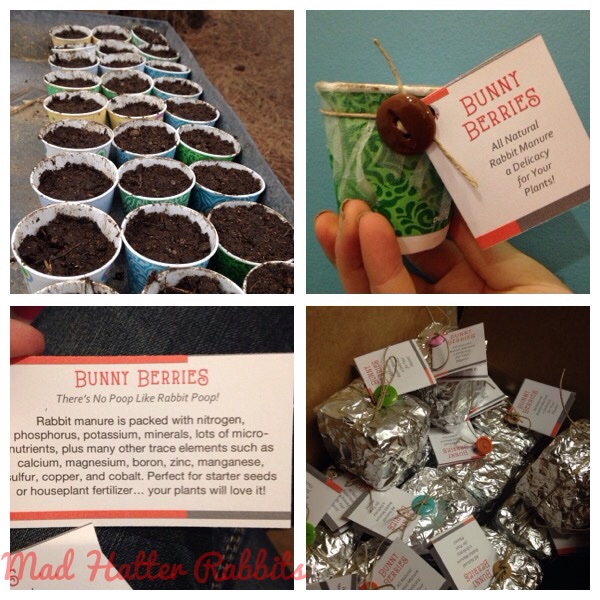
The display of our bunny berries at the craft fair.

The display of our bunny berries at the craft fair.

We have been stretching all of our boundaries lately.


Earlier this year we invested in a cubit press from the Urban Rabbit Project to make Rabbit Pots.  (For the unfamiliar, Rabbit Pots are cubes of compressed bunny berries (rabbit poop). These are excellent starters for seed sprouts, or can be crumbled over houseplants as a fertilizers. The cubit press can also be used to create fire starters and compressed fodder cubes.)


We have friends who are going through the adoption process and asked us if we could participate in their fundraising efforts by offering something to sell in a local craft fair. We were absolutely in favor of supporting them but yours truly doesn’t rank high on the “crafty” scale.


But we do have poop.


So, our family put our heads together and put together an assembly line packing moistened, aged bunny berries in Dixie cups and squeezing it into cubes. (Best case scenario will allow the poop to air dry thoroughly before packaging, although a dehydrator is also a good option.) Then we primped and packed our offerings to try to “gussy them up.”


The results:

Rabbit Pots

The Rabbit Pots we made are about three inches square. They’re a little delicate.

Bunny Berries

Dixie cups with compacted Berries make this a good option as a seed starter.


To be frank, the feedback we received is that the Bunny Berries were the talk of the craft show and people thought it was very clever but the sales were slow, as most of the craft show clientele (it was hosted in a retirement community) were more in the market for crocheted pot holders and scarves than manure… go figure!


The general take away is this is a good idea, but better marketed in Farmer’s Markets or at local plant nurseries. Either way, we’re glad to add this to our arsenal of ways to make rabbit relevant to every day life!

Give the Gift of Rabbits – Heifer International

HeiferI just received this wonderful reminder from Linette:

“Since this is a time of year many people think to donate to charities, I was reminded of the Heifer project which donates animals and farming equipment to people in developing countries. They have a program to purchase breeding trios for people who will raise them for meat.

It’s a wonderful way of sharing rabbits with people in need!”

heifer-international1

Moria chimed in, “We have done this a few times and it’s awesome to be able to share the love of bunnies and the reason they are so versatile to other people! And it’s not expensive at all! highly recommend it!”


Would you like to give the give of self-sustainability to those who might not have access to meat in other ways?

http://www.heifer.org/gift-catalog/animals-nutrition/gift-of-rabbits-donation.html


Share a rabbit c

Blanc de Hotot Sports — Photo and Classification

Obviously, this is not a rabbit. It is a sport. Or a hat. Your call.

Obviously, this is not a rabbit. It is a sport. Or a hat. Your call.

Don’t you just love it when something forces you to think and learn? We do!


Raising Blanc de Hotot have given us a whole new topic to explore and learn. To be frank, we’re just working to figure out the genetics piece, and I’m also deep in the research different factors affecting spotted rabbits.


Genetically speaking, the Blanc de Hotot is a black bunny with a really, REALLY large white spot! Here’s the starting point: the genetics of a purebred Hotot should be aaBBCCDDEEEnEnDudu. And the broken gene in an Hotot is also called the “English Spotting” gene.


I’m sure that means something to you genetic gurus out there. I’m still figuring it out, personally!


Since I’m not fluent with the genetic identifications here, another thing we’re learning is that different Hotot sports have different names. I’ve collected photos from around the internet with explanations of what these markings are called. Thank you to anyone who actually took these photos – in many cases I haven’t been able to identify the owner of the photo or rabbit.


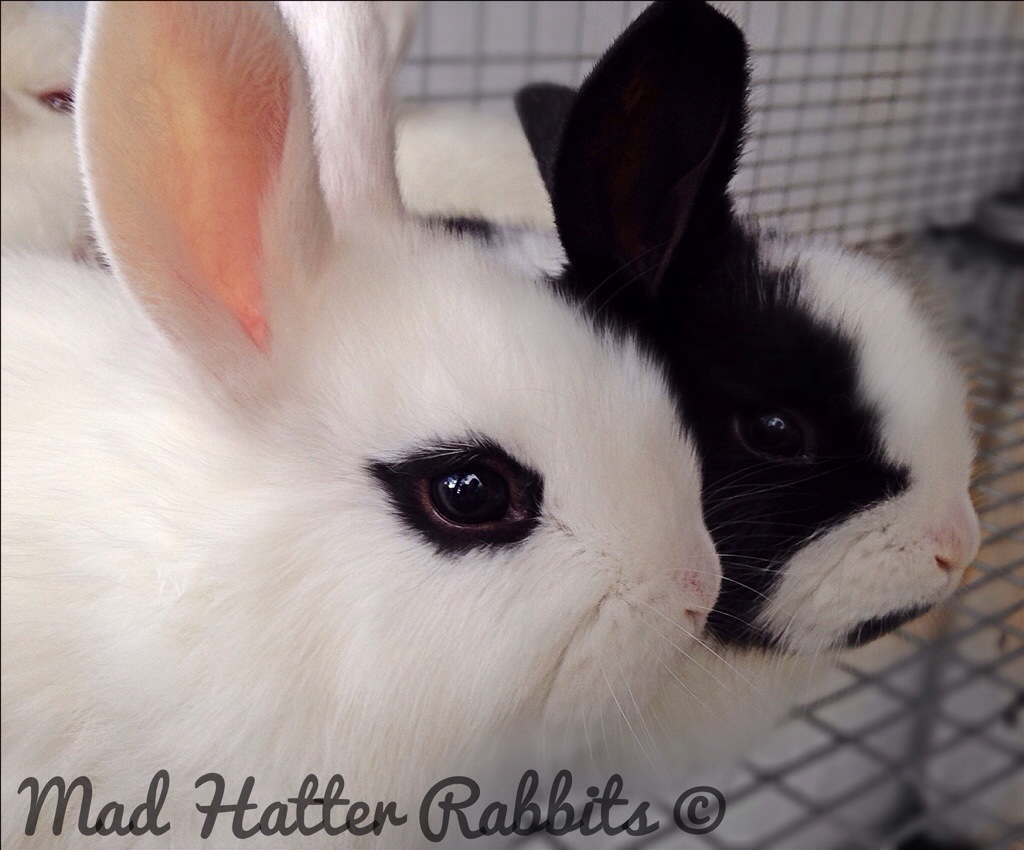
If a “broken” Hotot produces a show marked animal (dark eyes, white rabbit, black spectacles or eye bands) and looks like this:

Is this not a beautiful rabbit?!  Photo Courtesy of Autumn Denistoun

Is this not a beautiful rabbit?! Photo Courtesy of Autumn Denistoun


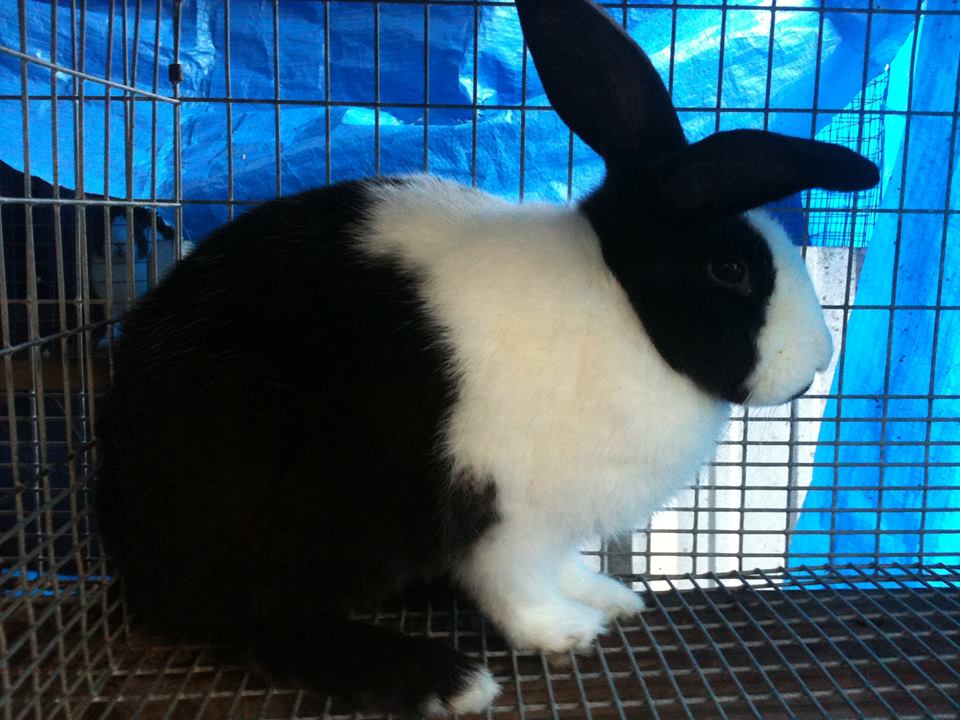
Then a “solid” Hotot produces a Piebald, which looks a lot like a Dutch rabbit:

20140706-100603-36363433.jpg

Photo courtesy of Evil Bunny Rabbitry

Photo courtesy of Evil Bunny Rabbitry

Now, within the piebald category there are also silver pied. This is a rabbit exhibiting the Dutch markings but with silvering throughout the black blanket of its coloring:


See the white silvering in the black? That's a giveaway that you've got an  hotot! Photo courtesy of L. Staley.

See the white silvering in the black? That’s a giveaway that you’ve got an hotot! Photo courtesy of L. Staley.

Piebald with spots - baby fur. Photo courtesy of L. Staley.

Piebald with spots – baby fur. Photo courtesy of L. Staley.


The markings of the Hotot also have specific names. When an hotot has only one eye (instead of both) with the black fur rimming it is called a boxer:

Finger is on the boxer baby. Photo courtesy of L. Staley

Finger is on the boxer baby. Photo courtesy of L. Staley

Older boxer, missing one of the eye bands. Photo courtesy of Evil Bunny Rabbitry

Older boxer, missing one of the eye bands. Photo courtesy of Evil Bunny Rabbitry


(And reminds me of Petey from Little Rascals!):


I know, wrong animal. Cute nonetheless, though, right?!

I know, wrong animal. Cute nonetheless, though, right?!


The original goal of the Blanc de Hotot was to build a breed of pure white rabbit with dark eyes. The woman credited with starting the breed is Madame Eugenie Bernhard of Northern France. Because of her influence, when you run across an hotot with NO eye bands at all, it’s called a Bernhard:

A bernhard, named after the founder of the breed, has no black rings of fur around their eyes. Photo courtesy of L. Staley

A bernhard, named after the founder of the breed, has no black rings of fur around their eyes. Photo courtesy of L. Staley


Another interesting variation of the Blanc de Hotot sport is the evidence of blue “marbling” in their eyes. Marbling refers to having blue spots or streaks on an otherwise brown iris. This is not a desirable trait, but does come up:

Most of the time the marbling will not be the entire eye, although it's possible for an entirely blue iris to occur.

Most of the time the marbling will not be the entire eye, although it’s possible for an entirely blue iris to occur.

Do you see the blue there in the bottom of the eye?

Do you see the blue there in the bottom of the eye?


Many times I am confused by descriptions and need a visual to understand what people are mentioning. I hope this little pictorial will help others as we learn about this wonderful breed. Many thanks to all who offered photos for us to see! We welcome your comments!


Blanc de Hotot Breeders

Hotot logoOne of the things we have committed to in our rabbitry is raising rare breeds in as quality a manner as possible. That means not only breeding them, but also culling hard toward the breed standard and promoting them whenever possible.

One of our breeds is the Blanc de Hotot. It is ranked #1 on the Rare Breed list and adds a certain challenge to the breeder because it is a marked breed – the Standard of Perfection calls for evenly marked black eye bands — “spectacles— round dark eyes on a perfectly white rabbit. Additionally, the fur has a frosty appearance due to longer guard hairs.

In our litters we often have show marked rabbits, as well as “sports,” those rabbits who aren’t completely white and have black markings on them in random spots. We see our spots most often in between the ears or along the spine. Unless a sport has incredible body type, we cull them out of our program, and are working toward having exclusively show marked rabbits. But it’s a long process!

One thing that often confuses people is that there is a difference between a Dwarf Hotot and a Blanc de Hotot. The Blanc de Hotot is what we raise, and it is a commercial breed rabbit… BIG! It’s comparable to a Champagne d’Argent, Satin, Silver Fox, Californian, or New Zealand. The Dwarf Hotot is also white with black eye bands but it’s a little thing, more along the lines of a Netherland Dwarf. It’s much more common to see Dwarf Hotot around, we have often gotten comments from people who are shocked at the size of the Blanc de Hotot because they’ve never seen them in real life!

Since the Blanc de Hotot are a rare breed rabbit, it’s often difficult to figure out where other breeders are located. There is a facebook group called Blanc de Hotot rabbit breeders that has been very helpful to us as we have gotten more involved with the breed. We recently came up with a breeder listing and now have a map to generally see where people are located:

We're a small but mighty group! Would you like to join us in preserving this rare breed?!

We’re a small but mighty group! Would you like to join us in preserving this rare breed?!

Doesn’t Arizona look lonely?! It’s just our single little dot on the map! We’d sure love to see other Blanc de Hotot breeders come forward and work with us to preserve this breed! They’re funny rabbits, solid for meat production, curious in temperament, and in need of people to work on improving their type and competitiveness!

Best Opposite of Breed, Silver Fox, ARBA National Convention 2014

Photo by L. Fischbeck

Photo by L. Fischbeck

We are just beside ourselves tonight with excitement because we got word that the doe we entered into the ARBA National Convention was placed as Best Opposite of Breed! It is such an treat to have your animal selected for this honor and it’s not something we expected as we waved goodbye to our transporter last Thursday night!


This particular doe was bred by Nick’s Nibblers in California — Nick’s Nibblers had Mad Hatter stock to get started in Silver Fox and we traded for Zelos earlier this year. Since she came out of Mad Hatter lines we felt it was still ok to send her as our entry, typically we wouldn’t plan to send a rabbit we haven’t personally bred to the National Convention.


Boy are we feeling blessed tonight, and grateful for how things turn out! On any given day every rabbit has a serious chance at top honors. Even though we didn’t place as best of breed, we’re still feeling pretty happy about her performance and eager to bring her home, get her registered, and send her legs in to complete her Grand Champion process before we start her down the merry path of motherhood.


So many thank yous to so many people who have assisted with the national show! We’re looking forward to seeing how our other rabbits placed, and preparing a welcome home treat for Zelos, our very first nationally winning rabbit!

My Rabbits Bought my Keurig

Our rabbit money purchased a Keurig for our family this fall.

Our rabbit money purchased a Keurig for our family this fall.

People will often ask if it’s possible to make money on rabbits.


No. (Kinda.)


Raising rabbits is a lot like the blogging world in some respects. There are some people, like the Pioneer Woman, who make money on their blogs because they have a massive following and sponsors. But for every Pioneer Woman there are 5,000 people who opened their free blog account and post on occasion and make nothing.


Kinda like rabbits.


There are people who run commercial rabbitries who are able to make money for themselves selling meat rabbits. There are some people who have worked very hard on their lines and can make money on sales for their rabbits that actually support them in their retirement.


But for the average person, rabbits can be a bit of a money pit, especially if you’re addicted to buying new stock all of the time and you haven’t clearly stated your objectives.


For our family, we have three priorities for our rabbits:


1. To provide a healthy meat source for our family, where we know what is in the food we are eating. In this respect we are paying about $3/lbs for rabbit meat when we process on a 10-week schedule. That takes in to account the amount of food consumed by mama while nursing the litter and the amount of food consumed by the individual rabbit until butcher time.

2. To produce show animals that pay for themselves. We enjoy showing. I get it that not everyone does, but we find it to be a lot of fun for our whole family. Showing a rabbit is not terribly expensive, but it does take money in gas, entry fees, purchase of carriers to get them to and from the show, and incidental costs while there, like a soda. If we are able to sell stock to cover the cost of our show experience we consider that a fun experience that pays for itself… and that’s a win-win. As time has gone on our rabbit sales have also slowly chipped away at the initial purchase cost of our cages and supplies. We have a depreciation schedule for this so I’m not expecting to break even but, it’s happening slowly!

3. To allow this hobby to bring our family together. This is a purpose that doesn’t have a price tag, but so many of the hobbies we see as options are not whole family events. We love to go snowboarding, but now that we have kiddos it’s a bit of a scheduling nightmare to figure out how to manage all the childcare so we can hit the slopes. Rabbits aren’t like that for our family – we come together to take care of the daily husbandry tasks and when we go to shows we are often en masse with the kids and have found rabbit people to be extremely welcoming to well-behaved children.

We also recognize that rabbits have become our family hobby. Hobbies of all types exist in the world, but usually you expect to have a bit of expense involved whether it’s buying a specific size of knitting needle or yarn, or a special rope perfect for bouldering. Hobbies come with a price tag – ours also comes with fur!


The first year we had rabbits I fretted quite a bit over the monthly budget allowance we had going to the animals, thinking we would never break even. We sell our animals to people for show and starting their own meat operations, and have gotten a fairly steady stream of people who are interested in purchasing the poop — ‘bunny berries’ — for their gardens, which brings in a little extra cash. Now that we’ve been at it awhile, we also have been able to scale back our regular costs significantly to basically food and shows.


That has left a little extra room on occasion to save for bigger upcoming expenses. Dollar by quarter we are able to set money aside… and just a few weeks ago I was able to completely pamper myself by buying a Keurig coffee maker using our rabbit profits! So now we’re caffeinated as we pet our bunnies, a crazy combination! Ha!


I suppose when it comes down to it, it’s about your priorities. I would never recommend rabbits to someone as a money-making proposition. If you’re interested in a rewarding hobby with lovely relationships with others and potential to make a healthy lifestyle choice, this might be right up your alley!