How Much is Too Much to Spend on a Rabbit?

Yep. Been known to Happen.

Yep. Been known to Happen.

The ARBA national convention is this weekend and I’ve been having several discussions with different breeders about their purchasing budget.


Convention is a two-edged sword, because on one hand it’s a wonderful opportunity to spread bloodlines across the country and have access to livestock you can’t normally get because of distance. On the other hand, a rabbit purchased through Convention is typically much more expensive – maybe double the price or more – than a rabbit you can get locally once you add up the purchase price, transport cost, care cost, and entry fees.


So what’s the right choice? To buy… or NOT to buy? This is the question!


Everyone will have to come to their own conclusions, but this is how we look at it.


1. Gene Pool. We are raising rare breed rabbits. The ability to mix up bloodlines is pretty important – over generations sticking to the same gene pool will lead to a smaller sized, genetic abnormalities, and type characteristics that won’t help the breed long term. So getting new blood is worth the expense to us in that respect.


However, we don’t want to buy just anything willy-nilly. When we were first starting out I was interested in buying stock from anyone that had rabbits available. Now that we’ve gotten our feet wet and know our own lines, we can selectively choose animals that will (hopefully) add a specific trait to our herd. No herd is perfect! Part of what makes rabbit breeding so fun is seeing the changes in quality in your herd over time. Convention provides a perfect opportunity to gain access to a wider spectrum of rabbits.


2. Cost Analysis. From a purely practical standpoint, each rabbit has a cost/benefit. Let’s say a rabbit’s purchase price is $100. (That’s a nice even number). It’s a doe and she has a litter of 7 – of those you sell 2 and cull the other 5 for meat or such. Even if you sell the two babies for $50 each and the culls at $5 apiece you’ve made your purchase price back off of just one litter, while your original rabbit might produce ten more litters for you in her lifetime… or you might sell her as a proven doe at some point later in her life, recouping some of her original purchase price.


With that in mind, I find it easier to spend more on a Convention rabbit, as long as I keep a longer-term outlook about it. Over time rabbits will pay for their own food, the cost of physical rabbitry (cages, water bowls, etc.), any miscellaneous costs, BUT it’s not going to happen in six months. It’s a multi-year process and in the meantime you have to guard your own reputation and make sure you’re keeping your rabbitry clean, rabbits healthy, and selling stock buyers are excited to have and can (hopefully) win for them or produce great litters for their own livestock operation.


3. What’s Practical Now. When we were just getting started I practically mortgaged one of our children to get stock! Well, that’s overstating it quite a bit, but at that season I felt we had to snatch up the opportunity to get animals out here, since no one in our area was breeding some of these breeds. Fast forward a few years and now I’m staying within my budget and passing on animals I wish we could buy because I already said yes to some offered earlier.


Just a piece of marital advice, stick to your budget! My husband told me I could only buy rabbits with money rabbits made this year and it’s caused a few pains when I passed on a great animal… but a whole lot of peace with my spouse! There will always be more rabbits, I only want one husband!


So there you have it! It’s not a straight up  answer to how much YOU should spend on your animals, but at least a glimpse of how it’s working for us right now. May all your purchases be positive!

Silly Wabbit, Jokes are for Judges!

Laughter is good for the soul.

Laughter is good for the soul.

When we go to a rabbit show I am always very eager to hear what a judge has to say about our rabbits. I’m interested in all the comments, because if I can start seeing what a judge is seeing when they evaluate, I will only get better at breeding toward the Standard of Perfection at home.


There are many times I begin to feel a little sorry for a judge, however. When faced with a table of multitudes of rabbits that are practically identical, how on Earth do judges come up with something to say about every single rabbit?! Those judges who come up with creative descriptions get my kudos – and a nod toward a legacy with their words being immortalized in the blog-o-sphere!


Here are some of the most memorable judges comments shared by other rabbit breeders:

“This buck poses like a football player because he leans forward and braces like a linebacker.”

“This doe has shoulders like a quarterback.”

“Flat as road kill…”

“The head is just horrible but behind that, it’s Disneyland!”

“This doe just isn’t wearing her party dress today.” (with fur flying from molt)

“(I’d) only like Lionheads if they had a long tail with a broom type fur at the end & fangs!”

“(She’s) so little she still had milk on her breath.”

“Very nice buck, but the color is Yuck!”

“Nice arse.”

{Rabbit molting} “An outstanding individual but just needs a fresh coat of paint.”

“This rabbit would look great, (big pause) in a big pot right next to some potatoes & carrots.”

“This is a movie star rabbit – she’s got the body of Marilyn Monroe and the head of Phyllis Diller.”

English Spot who was congested: “And the hunter didn’t quite get him.. The pellets all hit here.”

“You can bounce a quarter off that rabbits back.”

A judge kissed one of my Florida Whites and asked her, “As cute as you are, I wonder if you would be just as tasty?!”

“This one seems to be a little over conditioned.”

“This doe has a butt ‘SMOOTH AS BUTTER!”

“This guy has such incredible fur, I just want to rub him all over me.”

Years ago someone asked a breeder how she got such nice, big rear ends on her Satins after winning BOB and BOS. Her response: I walk down the barn and tell them “Look at momma!”

“Really nice coat and not a lick of sense.”

“Lacking color…” (on a REW!)

A judge back a {my rabbit} and said “pick another one to love.”

“Looks like moths got to this one.”

“This animal’s coat is so dense that if I stuck my face down next to it, it would literally punch me in the face!”


Thank you, judges, for keeping us entertained – we look forward to the next round of fun descriptions!

Rabbit Breeders Alert Network (R-BAN)

Even Einstein was smart about bunnies.

Even Einstein was smart about bunnies.

Those of you who are on Facebook may be interested in a newly formed group, Rabbit Breeders Alert Network (R-BAN).


The group was formed this past week with a goal of helping fellow rabbit breeders be aware of potential disease risks in an area for protecting their rabbits as well as legislative action alerts pertaining to our hobby and right to raise rabbits.


Some examples of posts are the following:


Myxamatosis epidemic spreading in California. Coastal regions reported from Monterey to Sonoma Counties. Latest reports are inland to Fresno area. Myxamatosis is spread by insects such as mosquitoes and fleas, and is hosted in wild cottontail populations in CA and OR. Prevention is the best remedy: keep your rabbitry free of mosquitoes, fleas, any biting insects. Note that once infected rabbits are present the disease is also transmitted by hands and clothing. Symptoms for the disease range from sudden death within 2 days, to 12 days of virus incubation then rabbits eyes swell up and rabbit becomes lethargic, sometimes suffocating from secondary pneumonia. Cases in other countries reported to have some survival rate, the CA strain of virus does not have any reports of survival rate. Vaccine available in the UK but for some reason not here?? If purchasing rabbits from CA and OR it is recommended you quarantine them in a bug-free zone for two weeks.


Another post:

This is a message from BOB GLASS!!! from RABBIT PASTEURELLA VACCINE FORUM

Pan American Vet Labs is undertaking a research project on Enzootic Rabbit Enteritis (ERE). This disease, which causes bloating, diarrhea and death, has been ravaging rabbit herds worldwide for several years and has been proven to be an easily transmitted infectious disease but the causative agent has not been identified. ERE impacts weanling rabbits most severely, killing 50-75% of those that develop symptoms. The course of the disease typically follow these general steps…:
1) 7-14 after weaning the infected rabbit shows a (usually) single large fecal discharge that is almost entirely jelly like pale yellow to brown mucous
2) the patient stops eating and drinking
At +/- 24-48 hours
3) the abdomen swells as the intestinal tract becomes “paralyzed” and large amounts of gas develop
4) the patient becomes weak and refuses to move
5) liquid green diarrhea of varying amount
6) the lips and tongue develop a blueish color
7) the patient dies
We are working on a new approach to isolate the causative agent and need some help. Our goal is to identify the agent, develop a diagnostic test to confirm disease and eventually a vaccine to prevent infection.
We need samples of the mucous material that is the first sign of infection and we need it as soon as possible to do preliminary studies to validate our study hypothesis. We need samples from several herds in order to prove that this is the same organism in each outbreak. Time is critical, we are applying for a grant to fund a portion of this study and the deadline is only a few weeks away. It is very difficult to obtain funding for “rabbit health” issues. We need data from these samples to add validity to our proposal. We will not reveal the source of the samples to anyone and we will share anything we learn about this disease.
Over the last 18 months I have spoken with dozens of rabbit breeders who are dealing with this infection in their herds and I am asking that anyone who currently has this disease please contact me as soon as possible if you are willing to send samples.
Get info on how to send samples here: WWW.PAVLAB.COM

Many times breeders aren’t aware that others are facing health issues in their rabbitries or what treatments have been successful or unsuccessful in combatting the issues. This forum is designed as a way to alert others about what may be spreading across various areas of the country and how to manage the issue.


We’re in favor of anything that helps these animals stay healthy and productive! If you’re interested, head over to Facebook and join the Rabbit Breeders Alert Network (R-BAN).

Youth Discounts & Questions

on-vase-34We have been privileged to work with some excellent young people who are looking for a quality start or continuation of their rabbit projects for 4H or just because they love the breeds we raise! We have children ourselves, and we hope that they will love rabbits through their whole lives. It makes sense to invest in the children who will one day be adults directing the atmosphere of the rabbit world.

Because we have chosen to take a long-term view of the benefit of kids working with rabbits, we will do our best to offer our best stock to young people so they have a chance to work with a great rabbit with reasonable ability to compete strongly. No one likes a loser and it’s not fair to give a child a cast-off rabbit that will not be a winner just because they’re young and need a discount. We feel pretty strongly about this because we want to set kids up for loving this hobby their whole lives… but that’s just us and I’ll get off the soap box now!

One of the ways we work with youth is to offer a lower purchase price for our rabbits, but then also give them the options of gaining an even greater discount by answering rabbit trivia questions correctly. We compiled a list of questions and answers about rabbit raising – when we have an interested youth we let them draw as many as three questions from a fishbowl. Each correct answer is equal to a $5 discount off the purchase price of their rabbit.

Here are the questions we’ve come up with so far. I’m sure over the years we’ll come up with more, but it’s a good starting spot! ** If you have additional questions we should add to this list, please put them in the comments!

Youth Discount Rabbit Trivia Questions
1. Why are rabbits a good livestock choice in an urban area? They produce more pounds of meat per pound of food consumed than other choices, can be kept in a relatively small space, are practically silent, and their manure can be used for backyard gardens, etc.
2. What is the national professional organization for rabbits? ARBA (American Rabbit Breeders Association)
3. What is a good rule of thumb for cage size for a rabbit? 1 square foot per pound of rabbits adult weight.
4. What is more dangerous for a rabbit – warm temperatures or cold temperatures? Warm temperatures. Rabbits actually thrive in colder temperatures and are quite happy even in below freezing temperatures.
5. When raising a meat breed, what is the ideal weight the rabbit will hit by 8-10 weeks of age? 5 lbs.
6. What is the average gestation (pregnancy length) for a rabbit? 31 Days.
7. What is a male rabbit called? Buck
8. What is a female rabbit called? Doe
9. What makes up a trio of rabbits? A buck and two does.
10. What is a rabbit cage called? Hutch
11. When is the best time to feed your rabbit? At the same time every evening.
12. What is the large fold of skin at the throat of a female rabbit? Dewlap
13. A domestic rabbit can be bred with a wild cottontail rabbit. True or False? False – They are different species.
14. A domestic rabbit can be bred with a wild European rabbit. True or False? True – Domestic rabbits are descended from wild European rabbits.
15. How many teeth does a rabbit have? 28
16. Name two ways to control disease in the rabbitry. Keep hutches, food & water containers clean, do not lend rabbits, quarantine new rabbits, provide fresh food and clean water, bury or burn dead rabbits, good ventilation
17. What mammal order are rabbits classified as? Lagomorphs
18. Where are rabbits believed to have originally come from? Spain
19. What is a pedigree? A record of a rabbit’s date of birth and three generations of ancestors.
20. Who originally is believed to have introduced domesticated rabbits to England? The Romans
21. What is the extra claw on the inside of the front leg? Dewclaw
22. A rabbit’s teeth grow 1/2 inch or more per month. True or False? True
23. What is the most common feeding problem? Over feeding
24. Name three parts of a rabbit besides eye, ear, nose, mouth, foot or tail. Cheek, dewlap, chest, toe, rib, belly, flank, hock, leg, shoulder, hindquarter, forequarter, rump, hip, loin.
25. What is a baby rabbit called? Kit
26. What is a group of kits? Litter
27. What is the mother of a rabbit called? Dam
28. “Variety” is a term for what? Color
29. When do a baby rabbit’s eyes open? 10-11 days
30. What is the father of a rabbit called? Sire
31. How many generations are on a full pedigree? Three (parents, grandparents, great grandparents)
32. At what age should kits be weaned? No earlier than 4 weeks, 6-8 weeks preferred
33. Which ear do you tattoo on a rabbit for identification? Left
34. What book lists pictures, descriptions and standards for all the breeds? The ARBA Standard of Perfection
35. Name two types of records that are important in good rabbit raising. Expenses, Income, Pedigrees, Show Records, Hutch Cards, Doe Records, Buck Records
36. Name a Commercial breed. French Angora, Giant Angora, Satin Angora, Blanc de Hotot, Champagne D’Argents, Californian, Cinnamon, American Chinchilla, Creme d’Argent, French Lop, Harlequin, New Zealand, Palomino, Rex, American Sable, Satin, Silver Fox, Silver Marten
37. What is an official ARBA document indicating that a rabbit is of good quality and meets the standard for it’s breed? Registration
38. How many times a day does a doe normally nurse her young? Once
39. Rabbit show category for breeds having an ideal adult weight of under 9 pounds? Four-Class
40. Rabbit show category for breeds having an ideal adult weight of 9 pounds and over? Six-Class
41. How many rabbits are in a Meat Pen entry? Three

42. What is the maximum weight of a Meat Pen rabbit? Not over 5 pounds.

43. Name a breed in the cylindrical group. Himalayan

44. Name a breed in the Full-Arch group. Belgian hare, Britannia Petite, Checkered Giant, English Spot, Rhinelander, Tan

45. Name some rabbit disqualifications. Abnormal eye discharge, colds or nasal discharge, mange, ear cankers, vent disease, abscess, split penis, malocclusion, marbling, pegged teeth, sore hocks, screw tail, missing toe, wall eye, spots

46. Name a breed in the Semi-Arch group. American, Beveren, English lop, Flemish Giant, Giant Chinchilla

47. Name a breed from the Compact group. American Fuzzy lop, English Angora, Standard Chinchilla, Dutch, Dwarf Hotot, Florida White, Havana, Holland Lop, Jersey Wooly, Lilac, Mini lop, Mini Rex, Mini Satin, Netherland Dwarf, Polish, Silver, Thrianta

48. What are the five groups of ARBA rabbits? Semi-Arch, Compact, Commercial, Cylindrical, Full-Arch

The Rabbit With No Ears and Big Teeth

It was a rough day around the rabbitry for No Ears.


If you’ve been following our blog for awhile, you’ll remember that back in February we had a litter of Cinnamon born where their first-time mother got over zealous in her cleaning at birth and ate the ears of several of her kits! Most were damaged only a little bit, but one poor rabbit had his ears bitten right down to the ear base.


No Ears' baby photo. He's ... the one with no ears.

No Ears’ baby photo. He’s … the one with no ears.


This little buddy has been known as “No Ears” since then. I wasn’t sure he’d make it through the summer, as rabbit ears are important for a rabbits body temperature regulation and our rabbitry is outside in Arizona! (It’s a mountain town but it can still get hot here!) He made it through the summer just fine but this afternoon… he’s hit a spot he probably won’t make it through.


We have children here. Our children get rabbits out and play with them almost every day. Our rabbits are loved, harrassed, and spend time hanging out on a trampoline with kiddos regularly.


When you have children and animals, there’s a special level of kindness necessary on the part of both the children and the animal. We think of it kind of like this – the children have to treat the animals in a way that will engender trust… and the animals have to not bite the children.


We’ve only had two biters around here and both found their way to the slow cooker almost immediately. Today, No Ears made the unfortunate choice of unleashing his teeth on my arm.


At this moment, he’s still breathing, but he signed his death warrant with that decision. Some might say we’re harsh to have such  black & white stance on the subject, especially since No Ears is the last of his line and has a pretty nice body type. I’m tempted to breed him before he hits the road… but we’re also firm believers that personality is a genetic trait as much as body type.


No Ears is a satinized Cinnamon, which I was looking to use to work with a torted Satin project. This photo was taken just minutes before "the incident."

No Ears is a satinized Cinnamon, which I was looking to use to work with a torted Satin project. This photo was taken just minutes before “the incident.”

No Ears has proven his mama was a biter and he’s a biter – I’m a little concerned about any animals produced out of him and their demeanor.


Do any of you have experience with this? Can you confirm or deny the biting tendency and whether it is passed down from generation to generation?


Setting Prices for Stock Sales

wendy's origami

wendy’s origami

If you’re anything like me, talking money can sometimes be uncomfortable. Especially if you’re not used to buying and selling.


When we purchased our initial stock, I was pretty determined not to spend more than $20 per rabbit. When I started researching the animals we were interested in, I realized that I would have to make some significant compromises in my expectations if I wanted a $20 rabbit – and even then, it was going to be hard to accomplish. Over time, I changed my philosophy, upped my budget, and found a sweet spot between what I am willing to pay for a purebred, pedigreed rabbit and what compromises I will make in quality in order to stay in my budget.


Obviously people have different budgets for their rabbit life, so  how do you come up with the prices for your own rabbits when it comes time to sell them?


There are probably a million different ways, but we connected with another breeder in our area who raised the same breed(s) and we discussed our pricing structure together. We ended up deciding on the same prices, which meant that we could refer people to one another for rabbits if they wanted gene pool diversity without having additional money conversations and we knew also that we could back each other up in our pricing and discussions of the value of the rabbits. This worked well for us as we both raised rare breeds.


Though we agreed for our area, we are not lock step with other breeders in the country for these breeds. For example, currently we sell our Cinnamons for $55/rabbit with discounts for multiples or 4H members. However, one awesome breeder in the midwest sells for $25/rabbit; another a few states away charges $125/rabbit. With a range like that, how do you know if you’ve got the right price on your rabbits?! How do you know you’re getting a good deal as a buyer?


Take some time to consider what you are selling.

  • Are your rabbits purebred? Pedigreed?
  • Are your rabbits being used for food, fur, or fancy?
  • If you show, how do your rabbits perform? Do they win top honors for the breed?
  • If you are working with meat animals what is your average litter size and mortality rate? What is the growth rate of your kits to 10 weeks? What is your dress out percentage?
  • If you are selling as pets, who is your market? A pet store? Craig’s List? Your mom’s best friend?

If you are a buyer, consider what you’re looking for?

  • What is your goal for your rabbitry? Food, fur, or fancy?
  • How important is it to you to have a pedigreed rabbit?
  • How important is your genetic diversity at this point? (At some point it might be worth importing a rabbit from another region of the country to widen your gene pool – that can be expensive.)
  • Are you hoping to sell rabbits yourself (if that’s the case, I’d strongly encourage you to start with pedigreed stock)?
  • Have you talked to breeders about who they’d recommend for purchasing your rabbits?


Once you have identified your goals it will become easier to determine your pricing structure. Investigate the websites of other people with your breed. Get on your breed’s facebook or yahoo chat groups and ask other breeders about their prices. Check out the ARBA results for your breed at the national convention and ask the winners what they charge. Cruise by your local feed store and price their rabbits.


All of these pieces of information will help you as you set up your own pricing. I will caution you, however – do not expect to make money on rabbits! I’m grateful those months that the rabbits sales cover the feed costs, which is only about half the time right now! Also realize that not every rabbit surviving to adolescence is worthy of being sold as a show rabbit and if you sell ugly rabbits for show or a sickly rabbit at any time your reputation will begin to precede you and you’ll find your sales will dry up.


We have a sales policy on our page that we worked on to protect us as the seller, as well as lay out clear expectations for the buyer. We often do our best to go above and beyond to make sure people are happy with their purchase. We are so pleased when we have repeat buyers! Our goal as a rabbitry is to be around for the long haul, which means that we have become more and more selective for what rabbits leave our rabbitry bearing our name. In our minds it’s a major accomplishment to send a rabbit out to another location and discover it’s regularly Best of Breed or a fair Grand Reserve. That’s good stuff!


Obviously, no one is breeding the perfect rabbit and everyone has to work on their own lines in order to know what their rabbits are actually worth. Once a rabbit leaves our rabbitry we have no control over how it is cared for or how it performs. That being said, we are doing our best to continually improve our rabbitry and the animals leaving – the search for perfection is quite fun!

Forget Free Willy, Free Bunnies!

It’s confession time.

For all we talk a good game of eating our uglies and realizing that everything has a purpose and sometimes that purpose is to be edible… Well, sometimes we just can’t pull the trigger.

Case in point: this is Eclipse.

IMG_0323.JPG

She is a fantastic Silver Fox doe who has given us a ridiculous amount of joy during her life. It has become evident that she is past her child bearing prime but we struggled with wanting to use every cage, every hole to it’s greatest impact.

So… Eclipse was turned loose in the back yard. She has been set free to hide underneath the saw horses supporting the Timothy hay bales and eat our lettuce sprouts. She loves it!

It’s been a few months since we got a freely roaming lagomorph and we weren’t sure it would suit us. But it has! Since then we’ve retired two more of our older does who have earned a special spot. There are a few more holes being dug in our back yard but it’s been working wonderfully.

The rabbits are living peaceably with our Great Dane and miniature poodle and it’s being done! They have not destroyed our feeble attempt at a garden and, as long as we keep them away from the bucks, I believe we have a winning combination.

A 10-lbs rabbit (or two… Or three) does tend to startle the uninformed, however. We had a friend over and when he saw the rabbit resting a few feet away from him he visibly startled. We all got a chuckle out of his reaction and the rabbits ended up coming over for scratches!

Feed Changes and Such

This summer has brought a few changes about in our rabbitry. I thought it might be interesting to give a “state of affairs” of the rabbitry.


We finished our permanent area and now have a set number of holes to work with, with the cages we prefer! This is several years in the making, so we’re pretty excited. We have upgraded our spaces so every single rabbit has a space larger than the recommended size for their weight.


We have used several different cage manufacturers. The majority of our cages are made by KW Cages. We find them easy to clean, sturdy, and I particularly like their door latching system. However, we also have several cages made by Klubertanz. Our Blanc de Hotot seem to have a streak of magic in them – they can be serious little escape artists! For awhile we simply put a carabiner on their door to keep them put, but we’ve learned that the Klubertanz latch system can defy even the most determined rabbit Houdini!


Earlier this summer we ran into a bad batch of food, which wiped out many of our rabbits. It was an incredibly painful experience for us. We buy our food in bulk and have used it successfully, so suspecting our food was not our first choice and we had a significant amount of finances invested in food NOT being the issue. In fact, I see so many posts on facebook blaming food for gut issues (that aren’t gut issues!) that I put a food change at the bottom of the list of possible problems.


We tried many different treatment options before making a switch but the very day we switched food — I mean, within an hour! — there was a noticeable difference in the atmosphere of the rabbitry and, from that moment forward, we’ve had no problems! We have watched for several weeks since then and have had no issues at all – as my friend told me, “You’ve experienced the pain of natural selection based on a hearty gastrointestinal tract.” Sigh. The good news is that we now can assume our remaining rabbits have stomachs of steel!


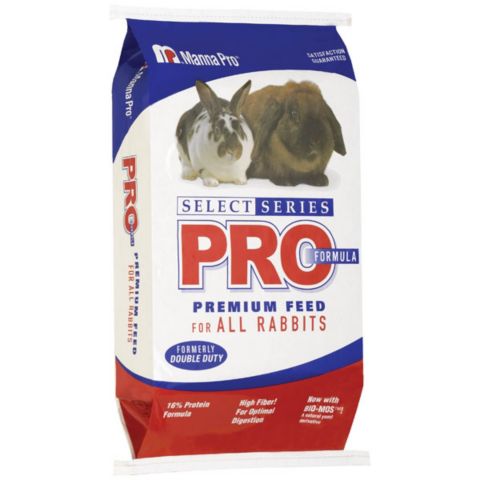
I am not a veterinarian and cannot promise results to anyone else, but here is the formula of what we did. We switched to Manna Pro feed, Pro formula, and also administered Rabbit Nutri-Drops via their water.

We switched to Manna Pro, Pro formula this summer.

We switched to Manna Pro, Pro formula this summer.

Rabbit NutriDrops

Rabbit NutriDrops


This combination had immediate results for our rabbits! We will stick with Manna Pro food for the foreseeable future, although we will only use NutriDrops in specific situations.


The NutriDrops came from a longtime breeder in the MidWest. He shared that he hasn’t lost a kit at weaning since he started giving them NutriDrops. It’s used by others as a stress fighter for shows. We simply put it in their water at home for three days. It smells exactly like the Poli-Vi-Sol vitamins that I have given my children when they are too young to have a chewable multi-vitamin. I can’t say the rabbits looked forward to drinking it… but it certainly perked them up!


The food issue hit our nursing mothers very hard. We had huge litters this summer in general – I need to double check if that had to do with moon breeding – but we had to do a lot of fostering in the end. Several of our rabbits had litters of 10+ babies when it was all said and done… and they raised them! Those mamas are getting a break from breeding for awhile, but we supplemented their food with Calf Manna while they were nursing.


Our rabbits LOVE Calf Manna!

Our rabbits LOVE Calf Manna!


Now, this is something the rabbits went crazy about! One mama actually knocked the cup out of my hand she was so eager to get to her Calf Manna! Calf Manna isn’t a supplement you’d want to use regularly, but it is useful for nursing does, weaning babies, and animals that need a little perking up.


We also fed hay until the world looked level! Our rabbits are very full of fiber… and they really seem to like it that way! I’ve discovered our Timothy hay has a different look depending on the time of year – it’s been fascinating to learn about the farming processes that go in to feed and hay and such!


We cannot express how grateful we are for the breeders who helped us do the sleuth work of figuring out what was going on! I researched rabbit gut issues probably close to a hundred hours without any success – and then a simple conversation with a breeder who has been in rabbits for decades solved the problem overnight. I truly regret not talking to a human being much sooner, as the internet (facebook included!) is not as useful as a real, live person. Having a rabbit community is so important!


We’re a few months out from the changes and I can confidently say our rabbits are doing great! They are thriving… and we’re learned another lesson for our rabbit tool bag!


Now… what will the fall bring us?!

A Rabbit with All the Fixin’s

Not so appropriate... but funny!

Not so appropriate… but funny!

This may seem like a silly statement given the website you’re on, but we don’t spay or neuter our rabbits around here.


We are of the belief that if we are raising rare breed rabbits to improve the breed and to provide for our family… we should actually breed the rabbits so spread the gene pool and cure the rumbly in our tumbly. (Logic, it’s a killer.)


However, there are several people around our area with some of our rabbits who keep them completely as pets and have ventured into the spay and neuter territory with their bunnies. While it’s a not a choice we will pursue, it has been the right choice for those owners.


There are a few behavior issues that come with sexual maturity in a rabbit. Bucks will spray or try to rub their scent all over anything they can touch (no joke – a friend had his rabbit trying to hump his feet!). Doe will become extremely irritable and even put out chunks of their fur in frustration. For some, the simple solution to these behaviors is to let the bunnies… breed like bunnies… but for others it might be a better fit to head to the animal hospital for a little snip snip.


Most rabbits fall under exotic pet veterinary practice. This might vary in your geographical region, however. If you decide to spay or neuter your rabbit you’ll want to check around to see if there is a vet who is familiar with rabbits. Many, many veterinarians are not! Rabbits tend to be sensitive to anesthesia, so you’ll want to have someone who is used to working with the lagomorphs or Fluffy Bun Buns might sink into sleep forever. My understanding is that you should expect to pay at least $100 for the procedure as well.


There is an argument out there that fixing your rabbit can extend their lifespan, however I’ve heard many rebuttals to that statement that rabbits are “cancer machines” and, as biologically evolving prey animal, they are going to pass on quickly anyway. I don’t have the personal research to weigh in on this matter myself, but I would definitely encourage anyone worrying about this to ask a LOT of questions of people before you make your final decision regarding the reproductive capabilities of a rabbit.


As I mentioned before, we have not chosen this route for our own rabbits, so if you have a personal story of success or disaster to tell, please do so in the comments!

Using Essential Oils on Your Bunny

So… we’re slowly becoming an “oily” family. We’ve been doing research on Essential Oils, the different companies, and how they work. We haven’t committed to any particular brand or theme as we go about our lives, but every night the kids get their “mellow mix” essential oil on their wrists and we use a mix of tea tree, lavender and chamomile on rabbit scratches all the time. Takes the sting out right away!


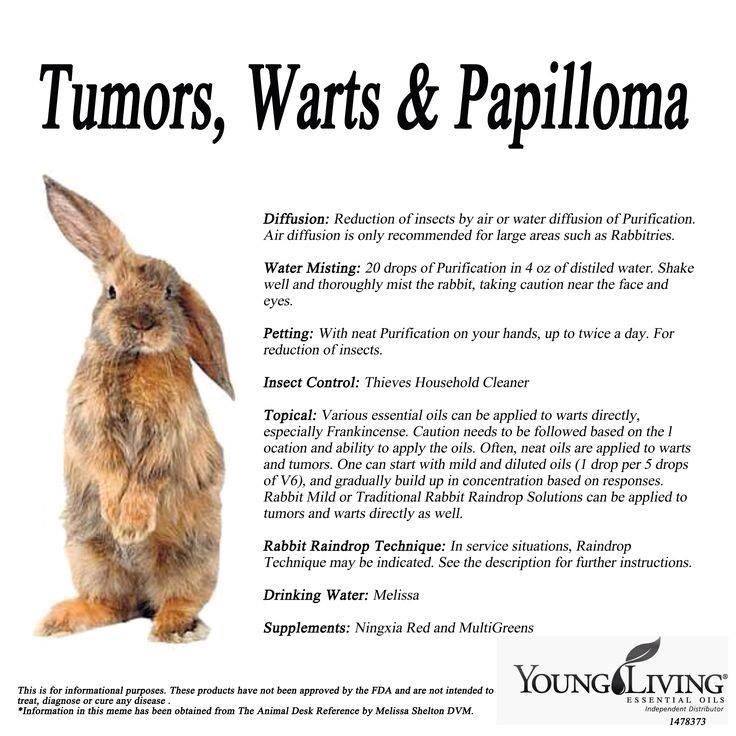
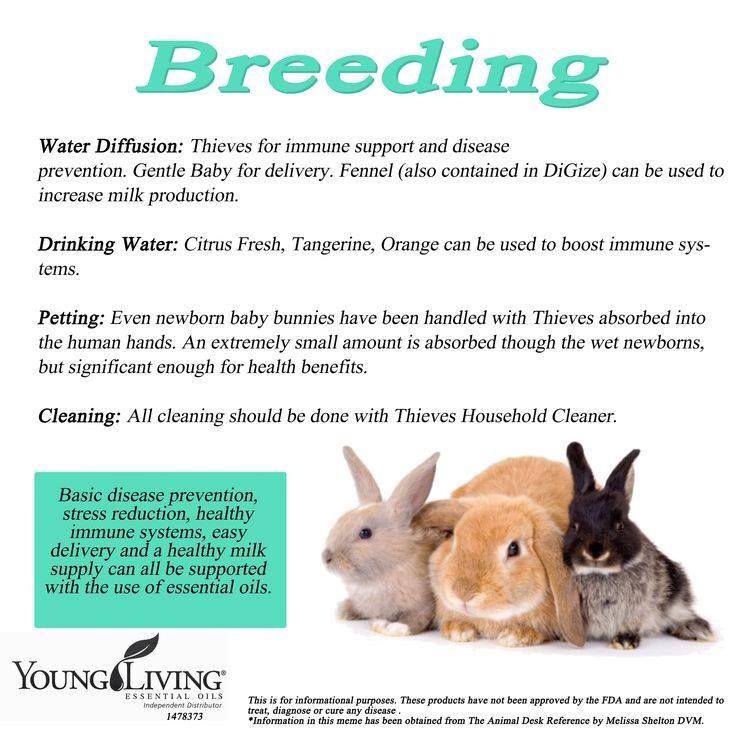
Because we’re so interested in this right now, I was super excited to see these infographics released! I have heard they need to be read carefully (for example, frankincense is allegedly poisonous to rabbits!). Here’s the upshot, this is not an endorsement of any particular essential oils company. Double check with an expert before you use any essential oils on your animals.


And… here they are! The infographics!


10450902_588556381265972_7197946688939265392_n

10473898_588556684599275_7225840526331296547_n

10444772_588556481265962_7054891664499790675_n

1487338_588556577932619_4404072703524151207_n


10462682_588556797932597_82091537180524855_n


10303947_588556917932585_3273905189073541540_n

10350340_588556957932581_3679100367932960682_n