Yearly Archives: 2013

2013 in review

The WordPress.com stats helper monkeys prepared a 2013 annual report for this blog.

Here’s an excerpt:

The concert hall at the Sydney Opera House holds 2,700 people. This blog was viewed about 27,000 times in 2013. If it were a concert at Sydney Opera House, it would take about 10 sold-out performances for that many people to see it.

Click here to see the complete report.

Using Apple Cider Vinegar with Rabbits

Apple Cider Vinegar has many health benefits for rabbits.

Apple Cider Vinegar has many health benefits for rabbits.

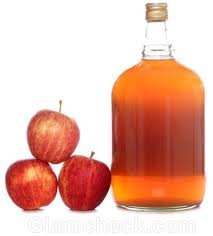
One of the quirky things we do around here for our rabbits is give them a bit of Apple Cider Vinegar (with the Mother) in their water every day.

Early on in raising rabbits we read that this additive is healthy for rabbits and incorporated it into our daily routine but today I decided to research exactly how and why it might be useful to rabbits!

We typically use Bragg’s Organic Apple Cider Vinegar (with the Mother) for our rabbits because A) that’s what’s stocked in our local stores and B) we like that it’s organic. We add about 1 Tablespoon per 1 Gallon of water and give it daily. The Bragg’s website says that research worldwide supports and commends what Hippocrates (the father of medicine) found and treated his patients with in 400 B.C: He discovered that natural, undistilled Apple Cider Vinegar (or ACV) is a powerful cleansing and healing elixir, “a naturally occurring antibiotic and antiseptic that fights germs and bacteria” for a healthier life.

The use of ACV has a long history. It has been traced to Egyptian urns as far back as 3000 B.C. The Babylonians used it as a condiment and preservative, while Julius Caesar’s army used ACV tonic to stay healthy and fight off disease. The Greeks and Romans kept vinegar vessels for healing and flavoring. It was used in Biblical times as an antiseptic and a healing agent and is mentioned in the Bible. In Paris during the Middle Ages, it was sold from barrels by street vendors as a body deodorant, healing tonic and a health vinegar drink. Christopher Columbus and his crew on his voyage to discover America in 1492 had their vinegar barrels for prevention of scurvy as did the soldiers in the American Civil War. For centuries in Japan, the feared Samurai warriors drank it for strength and power. ACV has been used for thousands of years not only for health reasons, but also as a cleansing agent to remove bacteria, germs, odors, and even stains and spots.

All of that is lovely to know and might help you out in a game of Jeopardy! someday, but what is Apple Cider Vinegar and who the heck is it’s “Mother”?!

ACV is an undistilled vinegar containing a potent combination of vitamins and minerals- including potassium, copper and iron, as well as magnesium and phosphorous. Potassium is key for growth, building muscles, transmission of nerve impulses, heart activity etc. ACV  contains natural organic fluorine, silicon, trace minerals and pectin. It is rich in malic acid which gives ACV its anti-viral, anti-bacterial and anti-fungal properties. ACV may help improve bowel irregularity and help to remove toxins from the body at a faster rate. Additionally, a few lab studies have found that ACV may be able to kill cancer cells or slow their growth (in humans).

Ultimately, there is nothing harmful in ACV so it can not hurt your rabbit – I like to think of it as a daily, natural multi-vitamin for our furry friends!

If you decide to use ACV, take care in your selection. It’s important you don’t simply get plain ‘ol Apple Cider Vinegar. Go for broke and get ACV with The Mother

No, this isn’t a Jewish-inspired guilt trip. You aren’t paying homage to the one who birthed you with your vinegar purchase.

Apple Cider Vinegar that includes “The Mother” contains raw enzymes and gut-friendly bacteria that promote healing. Vinegars containing “the Mother” will not be as clean in appearance as other vinegar options, but don’t be scared about this; natural ACV should be rich, brownish color and if held to the light you could see tiny “cobweb-like” substances. That is the “mother.” Usually  “mother” will show in the bottom of the ACV bottle the more it ages.  Seeing it is a good thing! Another tidbit of note is that ACV never needs refrigeration and should therefore never spoil on you.

Apple cider vinegar has many benefits for the domestic rabbit. Here are a few we’ve observed personally and also read about from other people’s experiences:

  • ACV helps reduce the ammonia smell of rabbit urine.
  • Prevents urinary tract problems like bladder sludge (from excess calcium), reducing infections because the organisms can not live in acidic urine.
  • Keeps the body pH regulated, clearing up any skin infections or weepy eyes.
  • Increases the nutrient absorption capabilities of the G.I. tract as well as helping the whole digestive process.
  • Boosts fertility rates and may result in more female kits in a litter.
  • Makes the does more willing to breed.
  • Makes rabbits unattractive to fleas and mites by making the rabbit”smell” off, making it a great repellent.
  • Extensive historical use and veterinary studies indicate that apple cider vinegar added to feed or water can cure a mastitis infection and reduce the transmission rates of the bacteria.
  • One part vinegar and one part water can be sprayed on [any pet’s] fur and rubbed in generously to the skin. Saturate the entire coat, and continue every day for a few days to a week; any flea infestation will disappear.
  • Can  be used as a cleaner for cages and crocks as well as keeping the green algae from growing in water bottles in the summer.
  • Known for keeping  fur softer and shinier.
  • If  bringing your rabbit to a show or transporting them, ACV water will taste the same as the water from home no matter what tap you use.
  • Rabbits like the taste of ACV and drink more water, resulting in better hydrated rabbits.
  • It’s safe to give to pregnant does, great for rabbits at any life stage.
  • Adding ACV to water changes the pH level of the water, lowering the freezing point of water (a handy benefit when you live in the mountains at 8,000 ft. elevation!).

Are you convinced yet? Give it a try! A tablespoon of Apple Cider Vinegar (with the Mother) per gallon is a good starting point. Some people use as much as two Tablespoons per gallon over time. At this point we really don’t measure anymore, just splash it into our gallon jugs, add water, and head out to refill crocks! We add it to the water on a daily basis; some people go on a three-month on/three-months off rotation.

Truthfully, apple cider vinegar is one of those things that some people discount and some people swear by. I was not able to locate any scientific studies regarding ACV and rabbits, but there is a lot of testimonial evidence that it has useful health benefits. At the very least, it will not harm a rabbit, which might make it worth the experiment for you.

Are you using ACV with your rabbits? I’d love to hear about your experience!

These were a few websites I found helpful while researching this topic:

Apple Cider Vinegar for Rabbits (Rise and Shine Rabbitry)

Bragg’s Apple Cider Vinegar (with the Mother)

8 Amazing Uses for Apple Cider Vinegar

How Do Rabbits Mate?

It’s going to be a little talk on the birds and the bees right now. Hopefully it won’t get too X-rated for you.

In order to get this:

It's a baby bunny.

It’s a baby bunny.

You really need to have this:

Bunnies mating. Artistically.

Bunnies mating. Artistically.

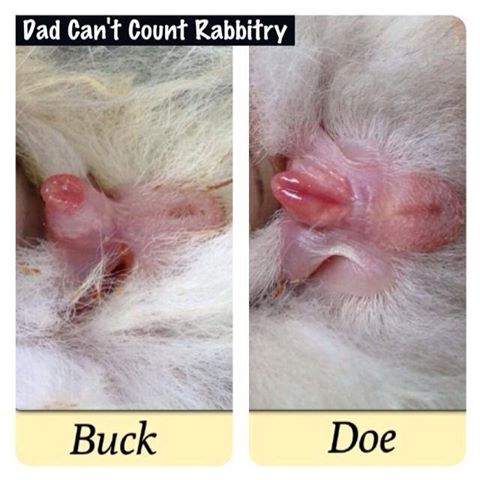
But before you get that, you should make sure you have one each of this:

1459159_467610133360598_2044988860_n

Once that’s all taken care of you might find something like this going on:

And, if you’re really, really lucky you might get a chance to giggle at live version of this:

All clear?


(Thanks to Google, Dad Can’t Count Rabbitry, Sky Island Livestock, and Jason and Crystal Mabb for the visuals for this post!)


(May all your breedings be productive!)

What a Crock!

626 / stock.xchng

626 / stock.xchng

Well, it’s happened.


Our water bottles froze solid in our mountaintop town last night, so it’s time to replace them with crocks for the winter.


Making sure your rabbit has access to water all the time is highly important for the health and security of the rabbit. We have moved all of our rabbits to large water bottles over the summer for the ease of refilling and the pure volume they offer. But when the temperature dip as they can here in the mountains, those water bottles just don’t cut it anymore.


We switch to crocks of water we refill at least two times a day. Last year I found a fantastic price on ceramic bread dishes as Michael’s craft store and stocked up. Our rabbits celebrate Christmas all winter long! This year we are using those crocks as well as EZ lock plastic dishes that attach to the walls of the cages.


We still have to watch the water dishes to make sure the rabbits have their water, but its our solution until we install a heated automatic water system… which is on the list of things to do but not too high!


Now it’s time to wash all those water bottles and get them in spic-n-span condition for the spring when we can use them again!

Exploring Genetic Generations

I hesitate to call our Astrex program an “Astrex program,” but for lack of a better term, that’s what I’ll use as a descriptor! This search for the curl gene has taken us on a massive learning curve, one which we are still exploring today!

One topic I’ve had to learn more about is simple genetic generation labeling. What on Earth does F1 mean? What about F2?! Here’s what I’ve discovered. (And, this is all new to the gal who barely passed biology in college. If I’ve gotten this wrong, please let me know in the comments!)

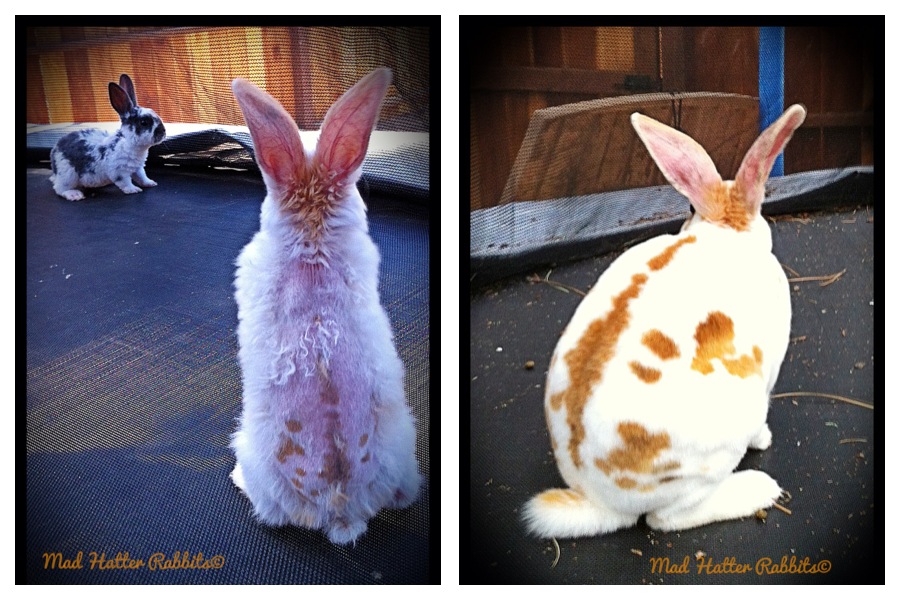
We discovered the curly coat in a litter out of two mini Rex, Bushy x Inca. Here are some baby coat vs. junior coat photos of two of those babies:

Grommet

Grommet

KickFlip

KickFlip

As you can see, the curly and baldness of their 4 week — 6 week age went to pretty straight fur into their 2nd and 3rd months.

These two rabbits are called F1 generation because they are the first generation of our Astrex program, put in another way, they are F1 generation because they are the immediate offspring of the original parents.

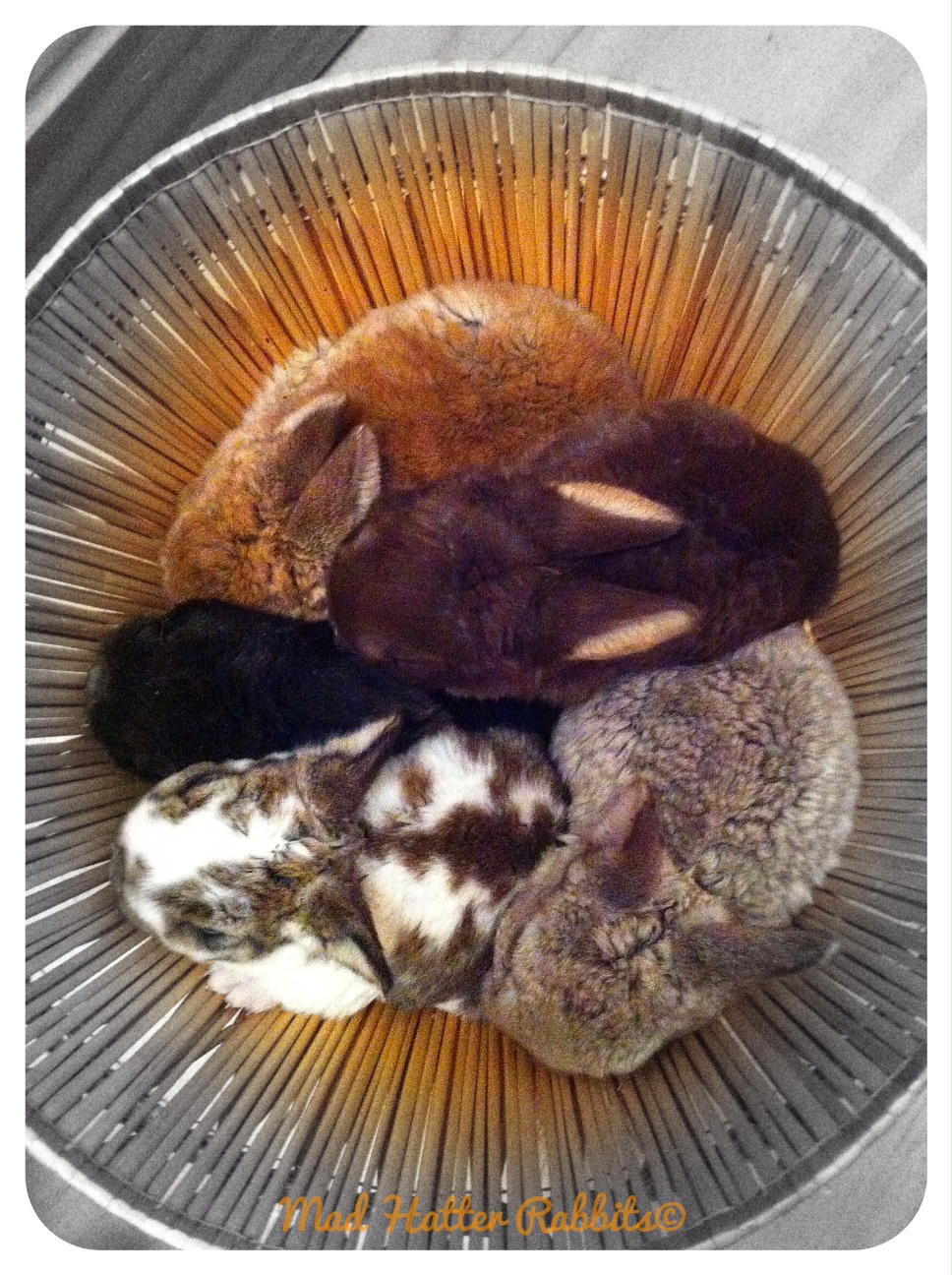
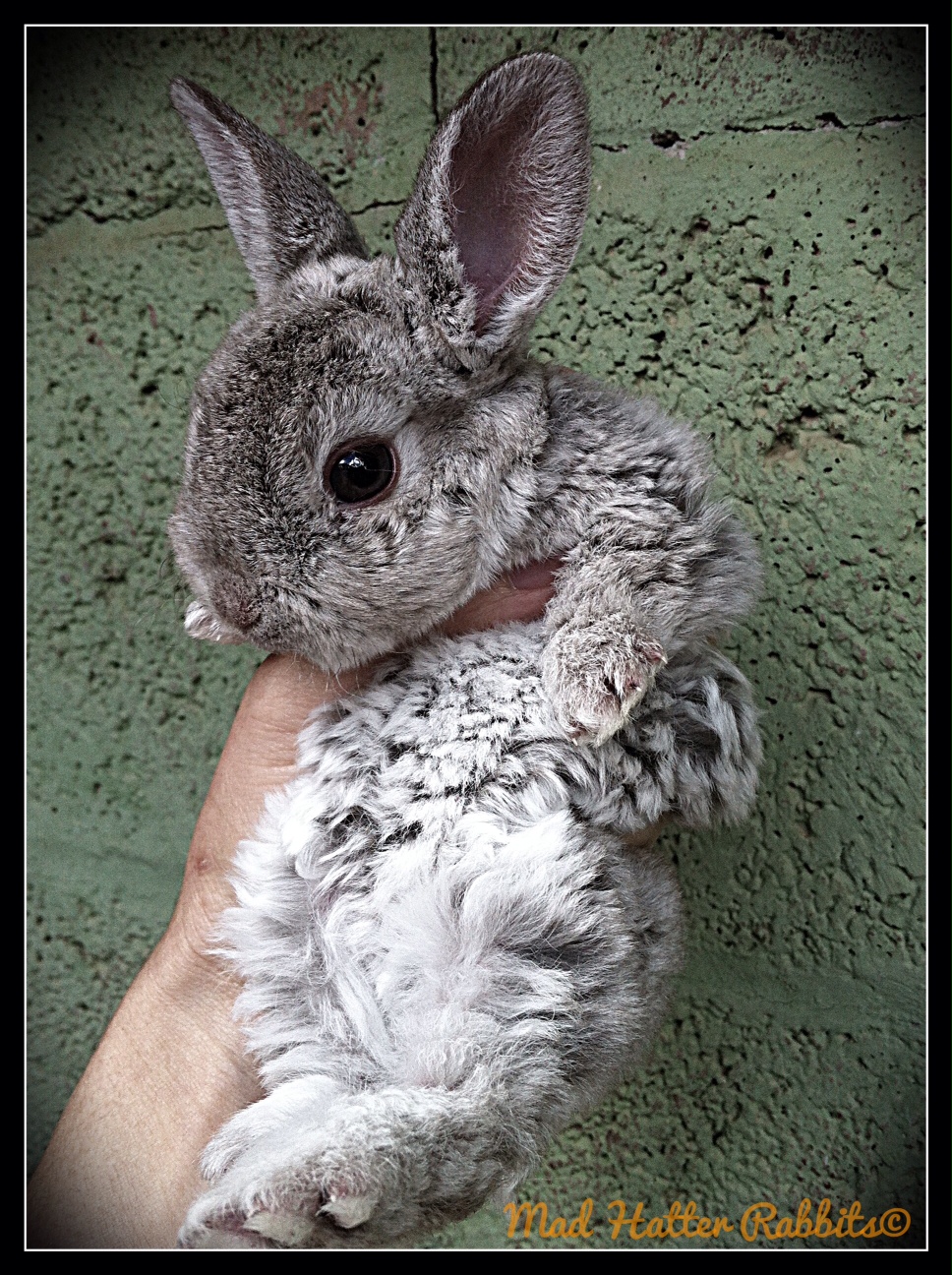
Here are some more photos of how the coat seems to be developing in the babies of our program. These photos are of a Bushy x Butterscotch litter, again, they are mini Rex. I’ve highlighted one of our favorites, Vanilla Icing:
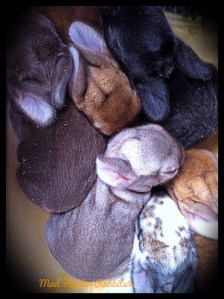
10 days

Bushy x Butterscotch, 10 days

21 days

Bushy x Butterscotch, 21 days

Vanilla Icing, 21 days
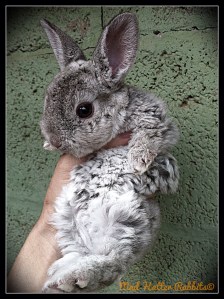
Vanilla Icing, 21 days

Vanilla Icing, 5 weeks A

Vanilla Icing 5 weeks

Vanilla Icing, 5 weeks B

Vanilla Icing, 5 weeks

Now, what comes next after the F1 generation? Well, creating an F2 generation, of course! An F2 generation is created when you breed two F1 rabbits together. The offspring of the two F1 generation rabbits are automatically F2 generation.

To add another level of confusion, in our breeding program, Bushy, Inca, and Butterscotch can all be termed P1 generation, or “pure parent generation.”

My understanding is that you have to breed through F8 generation before you’ve really recreated something separate and distinct that is able to match up to the hybrid vigor produced in the F1 generation. That gene can only be stabilized through careful selection for the trait you want – in each litter the odds are you will only have a handful of rabbits that have the curly coat you’re seeking (although technically all in the litter should be carriers).

I’ve also found references in several areas that the F2 generation typically has unstable genetics and may not produce consistent or vigorous results. Here’s another way someone stated the difference between an F1 offspring and an F2 offspring: “When (working with) F2 stock, the idea is to search out the better phenotypes, and clone them so in future you only work with the best genetics of the bunch. With F1 stock, you should have more uniform (animals) that all perform similar, and if the breeders done his job correctly, this should be as close to the original description that tempted you to (the animal) in the first place!”

Clear as mud? I know. It’s confusing to me, too. But I will say I’ve learned an awful lot about marijuana seeds, fish, and cats while doing this research! Who knew?

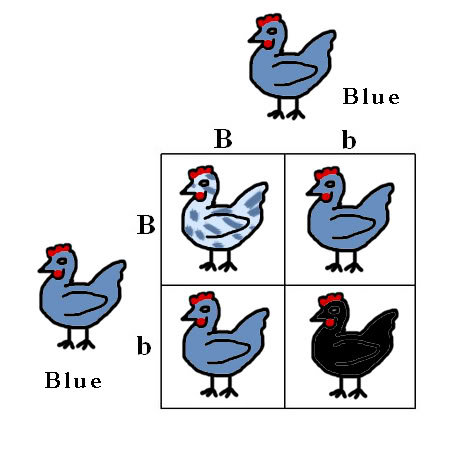
Let’s see if these diagrams can give us one last look at how to make sense of all this genetics stuff. Here’s a Punnett Square. I promise I won’t be testing you on your answers, but if you take a look at it you can see in a simple way how you might get traits passed in various percentages to offspring:

Basic Punnett Square using blue chickens. Aren't they cute? See how the colors change?

Basic Punnett Square using blue chickens. Aren’t they cute? See how the colors change?

Punnett Square using more variations. Don't panic - if you stare at it long enough it begins to make sense.

Punnett Square using more variations. Don’t panic – if you stare at it long enough it begins to make sense.

Now. Rabbits and generations don’t show up quite as well on a Punnett Square, so you can use the same concept in a Pedigree visual:
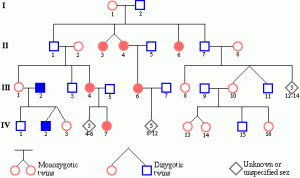
Pedigree Punnitt Square

Pedigree Punnitt Square

In a pedigree diagram, every row represents a single generation, and these are labeled with Roman numerals (or F1, F2, F3, etc.). Couples within the generation are listed from left to right across the line, and horizontal lines connect the reproductive partners. Vertical lines that descend from these pairs are indicative of offspring from the two parents. Individuals demonstrating a specific phenotype are indicated with filled shapes.

I got some help when a friend gave me this visual of trying to get the chestnut color in a rabbit:
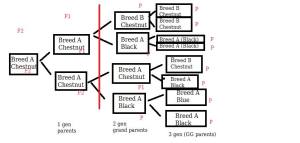
"Take a pedigree and count as far back as you can without reaching another breed. Draw a line to the left of that other breed and count the columns. Here is an example. This is a fake pedigree, crossing Breed A (which comes in black and blue) to breed B (which comes in chestnut) to make chestnuts in Breed A."

“Take a pedigree and count as far back as you can without reaching another breed. Draw a line to the left of that other breed and count the columns.
Here is an example. This is a fake pedigree, crossing Breed A (which comes in black and blue) to breed B (which comes in chestnut) to make chestnuts in Breed A.”

All you definition lovers, here is the way the Lionhead website defines their breeding programs:

“General Genetic Shorthand and Terms –
F1 is a purebred Lionhead crossed with a rabbit of a different breed. Mostly Netherland Dwarf, Polish. In addition some Britannia Petites, Florida Whites, Holland or Mini Lops and Mini Rex have been used. You may also find almost any other breed listed including Dutch, New Zealands and Rex!
It is questionable if a Lionhead hybrid without a mane can be considered a F1 generation because – to be considered a generation the offspring must look like the breed, meeting basic breed requirements. Many Lionhead breeders do count non-maned rabbits that are produced in a F1 Lionhead cross.

F2 is a F1 crossed to a Purebred Lionhead or another hybrid that is F1 or F2. It denotes another generation of Lionhead breeding.

F3 is a F2 bred to a purebred or a F3 or another F2. It denotes you now have three generations of Lionhead breeding before another bred shows on the pedigree.

F4 is the same as purebred. A F3 bred to another F3 or a purebred would produce bunnies with four generations of Lionhead on the pedigree. This is what is required by the ARBA (American Rabbit Breeders Association) to be considered for registration as a PUREBRED if the Lionhead was a recognized breed.

* Some people denote their crosses with percentage number such as 1/2 Lionhead or 3/4 Lionhead but the F system is recognized but almost all animal breeding materials, and is the form most commonly used.
HYBRID is a Lionhead that has rabbits of a breed other then Lionhead showing on a four generation pedigree.
PUREBRED is a rabbit that meets specific breed requirements and has a four generation pedigree showing individual information on each rabbit on the pedigree.
* Currently Lionhead breeders also consider Lionheads imported form overseas as purebred even though most do not have a complete pedigree.”

So, as I understand it, our Astrex program is going to go through some challenges for several generations as we try to stabilize the curly gene. It looks like anyone working with them is going to need a lot of patience and a long term vision!

As I’ve heard before.. I’m sure that all means something! Ha!

Now, what would you add to this short foray into genetics?

Entertaining your Rabbit

Canning lids are a favorite toy around here.

Canning lids are a favorite toy around here.

Many rabbit owners give their rabbits toys to play with – but it’s not necessary to spend tons of money on toys to keep your rabbit entertained.


Rabbits will play with anything from wiffle balls to golf balls and bells but are equally happy with bits of untreated 2×4 or sheet rock that doubles as a resting board. Natural options include apple wood and willow tree twigs, and pine cones. Baby teething toys like plastic key sets or evenshower curtain rings provide satisfactory noises when thrown around their home.


Toilet paper tubes, empty tissue boxes stuffed with hay, empty oatmeal containers, or boxes give rabbits lots of entertainment.


We’ve recently discovered the metal rings for canning jars are great toys for the rabbits. They’re metal and clang when tossed, plus we can put them in the dishwasher to sanitize and clean them up without ruining them!


IMG_4495


What do you give your rabbits as toys?


Moon Phase Rabbit Breeding

Krappweis / stock.xchng

Krappweis / stock.xchng

I don’t know about you, but I tend to check the Farmer’s Almanac before major surgeries like getting wisdom teeth extracted and when the winter weather map came out I pretty much decided it was gospel and made my plans accordingly.

I don’t have the slightest idea how the Farmer’s Almanac comes up with the stuff they print, but it seems to be proven over the course of time. To be honest, I don’t even read my personal horoscope, so it’s kind of strange that I’ll put stock in something that seems, well… hokey. I am most certainly a skeptic.

Along those same lines are the myths about breeding rabbits according to the moon cycle. There are people who swear they can predict the number of bucks and does born in a litter, the number of show rabbits, and various other items based on breeding their mama do on the waning and waxing, new and full moons.

And then there are those who say, “It’s a rabbit. Stop making it so complicated.”

I fall somewhere in between. Obviously there’s some truth to the idea or it wouldn’t persist… but it doesn’t have the trappings of the scientific method to quantify and qualify the hypothesis. After talking with obstetricians I’ve learned that hospitals typically expect a rush on their labor and delivery departments during a full moon; so whether proven or not, something must make sense about the moon cycle’s affect on the fertility process!

From personal experience I can say we typically breed according to a Breeding Calendar. I’ve discovered when I follow this schedule my does are usually perfectly happy to lift and accommodate the bucks… without it I usually see disinterest or downright menace!

Several of these sites suggest breeding on a new moon to have a doe-heavy litter and a full moon for buck-heavy litters. Farther than that, there’s a belief that moon phases can influence the quality of the litter. Here’s a snapshot I’ve learned from other sites:

Possible Outcomes when Breeding Rabbits by Zodiac Signs

Possible Outcomes when Breeding Rabbits by Zodiac Signs

So the idea would be to choose which outcome you want (i.e., best quality does), then check the moon phase, and breed your mama doe in that zodiac period during a fertile moon phase and, whammo!, you’ve taken control of a completely uncontrollable process! Ha!

Note – if this worked so scientifically, everyone would do it.. but when I asked other rabbit breeders to give me the birth dates of their best rabbits, every one of the initial 10 responders fit the above graphic!

I suppose the bigger question is: Why do we even care whether we have bucks or does? I heard one person say that more bucks being born was a sign of a hard winter to come. Others try to breed for specific genders so their prospects at large shows are better.

Interesting, huh? It’s an idea each person needs to decide independently, but if you have personal experiences that either prove or disprove these breeding methods, I’d love to hear them in the comments! We will continue to breed based on the calendar, and if I get my act together enough maybe I’ll do some comparisons for gender and litter size in the future.

In the mean time, here are some links I’ve found helpful when educating myself on this topic:

Moon Phase and Gender (via Courtney McCullough’s 2012 California State Science Fair Project) – Results: “The results of the data showed a distinct trend toward a correct hypothesis (that more does would be born if bred during the full moon and more bucks would be born from a litter bred during the new moon). The total number of kits born was 108, with 57 bucks and 51 does born, a typical percentage one might expect; however, during the full moon, there were 7 bucks and 25 does born, and during the new moon, 29 bucks and 9 does were born. When breeding in the middle of the moon phases, there were 21 bucks and 17 does.”

Moon Phase and Litter Size (via Natalie Davis’ 2010 California State Science Fair Project) – Results: “Over 300 individual litters indicated that rabbits bred during a full moon phase had an average of more kits (3.2 kits), than rabbits bred during a new moon or a waxing/waning moon phase (2.8 and 2.7 kits).”

Rabbit Breeding and Moon Phases (via ThreeLittleLadies) – information posted is from 2006 but provides a framework someone with skill in knowing the zodiac and moon phases could recreate fairly easily.

2013 Breeding Calendar (via BunnyRabbit.com) – We use this calendar to plan our litters

2014 Breeding Calendar (via BunnyRabbit.com)

2015 Breeding Calendar (via BunnyRabbit.com)

2016 Breeding Calendar (via BunnyRabbit.com)

2017 Breeding Calendar (via BunnyRabbit.com)

2018 Breeding Calendar (via BunnyRabbit.com)

2019 Breeding Calendar (via BunnyRabbit.com)

2020 Breeding Calendar (via BunnyRabbit.com)

How To Tell Your Kids What’s For Dinner

Meat processing may not be the oldest activity in creation, but it's close!

Meat processing may not be the oldest activity in creation, but it’s close!

When we began raising rabbits it was to provide an organic meat source for our family. We did a lot of research and discovered rabbit meat is one of the healthiest meats around, rabbits are easy to raise and relatively inexpensive, and they are quiet, making them an ideal choice for our vaguely-urban neighborhood.


Even though it was a logical choice for us, the reality of having children is that what makes sense to an adult is not always sensible to a young one! Many people have asked us how our children react to knowing we’re having rabbit for dinner so this seems like a good place to address their questions.


Our major philosophy with butchering (and life!) is to be honest with our kids, answer any questions they have, invite them to participate as much as they would like (but never force them!), and to share our reasoning and the struggles we have with the process.


Make no mistake, taking life in any form is significant to us and not something we do lightly. I’m been known to apologize to an apple tree for picking an apple! (Yep, I know this is strange but it’s how I roll!) Knowing we have a reasoning and thought process behind it makes a huge difference for us.


I’ve found this article (Kids and Farming: How To Tell Your Children Which Animal Is For Dinner) has some great tips on preparing your children for livestock processing. They do a good job of giving pointers on how to work with your children through what some might consider a disturbing event.


Our children have had lots of question but in general are really unconcerned about eating animals we’ve raised. When I announce we’re having rabbit enchurittos for dinner, rejoicing is heard throughout the land! Ha!


Every child is different and each family needs to find their own comfort level, but here are a few things that have worked for our children as we discuss raising rabbits as livestock rather than pets:


1. Every rabbit has a purpose. We watched a movie called Hugo a while ago and I fell in love with the main premise behind the film: that everything is created to fulfill a purpose and bringing that purpose to fruition is a thing of beauty! On a basic, biological level, rabbits were created as food for others. This is why they reproduce so quickly, have such short gestation periods, and are relatively unintelligent, small, and nutritious. Though they can fulfill multiple purposes, perhaps as a breeding animal for stunning show stock or as a companion for a human, at their basic level they are prey. Allowing them to complete their function is a thing of beauty in the same way humans can fill different roles, perhaps as a mother, or lawyer, doctor, or garbage collector. Every thing has a role to play!


2. Rabbits are an object lesson. We encourage our children to a part of the harvesting process much as they would like. While processing we use our rabbits as hands-on learning; we take care to identify the different elements of anatomy, recognize what healthy animals look like or what we might see if an animal were sick; we talk with our kids about the food we feed the rabbits and why protein content in a pellet matters, about how access to hay enhances a rabbit’s life, and what methods of taking life are honorable, fast, and painless. There are so very many subjects that come up from an educational standpoint if you talk honestly with your kids about your motives and how every piece of this life puzzle fits together, plus this provides a fall back plan for them in the event of a major lifestyle change. Has anyone seen Hunger Games?!


3. Our meat shouldn’t come on a styrofoam container. While grocery stores are convenient and I visit one (or two!) on a weekly basis, we want our children to understand that milk doesn’t come in plastic jugs and meat isn’t naturally served up on a styrofoam container. Most people in the U.S. are one-to-two generations removed from a food-producing farm and we’ve forgotten that we are dependent upon nature and hard work to provide the food we need to survive. As parents, we talk with our children about farming and our commitment to providing for our own needs in as wholesome and healthy way as we have available.


4. We adopt an attitude of gratitude. We have willingly entered into a symbiotic relationship with our livestock. It is our responsibility to care for the rabbits in the best way we know how and we take our stewardship very seriously. We always talk with our children about how thankful we are that these rabbits are able to meet one of our foundational needs — to eat — and do not take the responsibility we have to the animals lightly.


5. Practical Anonymity. When it’s all said and done, no matter how much you talk to someone about the big picture and philosophy behind raising your own food, no one wants to know it’s Mr. Binkles on the dinner plate! From a practical standpoint, we won’t name rabbits unless we intend to keep them for a good while and we typically process and freeze the meat under the generic “rabbit” term for long enough that we can’t remember who was whom!


While this is a far from exhaustive list, I hope it provides a spring board for your own discussions with kiddos about livestock and food and our roles as consumers in this world.


Get the Blues

A few drops of blue food coloring per gallon of water has inhibited algae growth in our water bottles.

A few drops of blue food coloring per gallon of water has inhibited algae growth in our water bottles.

Until we have an automatic watering system we will be best friends with our flip-lid water bottles. I love these bottles and especially the flip top lids – it takes so much less time than unscrewing the nozzle of each bottle to fill with water!

One thing I DO NOT love about water bottles is that they can get “ew!”-stuff inside of them – algae, moths, dirt, etc.

Earlier this year I complained about this at the feed store and one of the workers suggested putting blue food coloring in the water. She told me the blue coloring would inhibit the growth of mossy-type things in the water bottles.

We tried putting 1-2 drops of blue food coloring per gallon of water for months and didn’t think much of it, it was under the category of “can’t hurt, might as well try.” We saw only minimal algae growth over the following months. When we ran out of blue food coloring we tried green for about a week – but that actually seemed to encourage growth in the bottles!

When it was all said and done, space was at a premium I was being cheap. I didn’t want to buy all the other colors of food coloring from the box of four colors I could buy at the grocery and only use the blue, so we finally just gave up on it and for several weeks we haven’t put anything but our normal Apple Cider Vinegar in the water.

Granted, it’s summer time and our bottles spend a few hours a day in direct sunlight, but the algae growth has been impressive! I could scrub those bottles every other day and they’d still not be clean. (If only I could figure a way to market algae – we have been able to produce it!)

Last week after examining the cuts on my hands from scrubbing the bottles – yet again – I broke down and ordered blue food coloring off of Amazon. It arrived yesterday and I’ve been happily dripping the coloring in the water again. I have no scientific proof that this works, but from our real-life assessment, a few drops of blue could be what you need to fight the algae growth in your water bottles, too!

Gardening and Composting with Bunny Berries

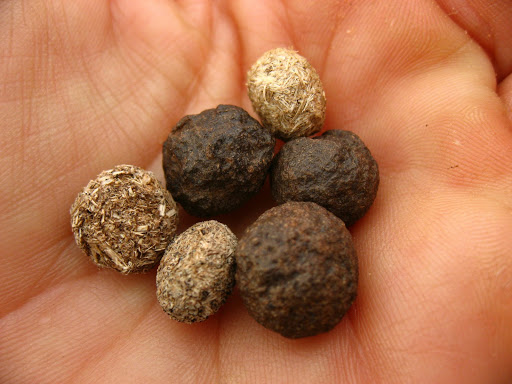
Bunny Berries are excellent for reuse in gardens.

Bunny Berries are excellent for repurposing in gardens.

There’s  no poop that works as well for the garden as rabbit poop. It has all the uber-benefits of horse and steer manure but with a distinct advantage: because it’s considered a “cold” manure, you don’t have to let rabbit poop age or compost before you use it. Other manures that come from chickens, sheep, horse, cows, and pigs or “hot” manures, need to be composted for months before you can safely use them or you’ll burn your plants to death. Not so with rabbit poop.

Rabbit manure is packed with nitrogen, phosphorus, potassium, and many minerals, lots of micro-nutrients, plus many other beneficial trace elements such as calcium, magnesium, boron, zinc, manganese, sulfur, copper, and cobalt just to name a few.

N – P – K VALUES 

Rabbit 2.4 -1.4 -.60

Chicken 1.1-.80-.50

Sheep .70-.30-.60

Horse .70-.30-.60

Steer .70-.30-.40

Dairy Cow .25-.15-.25

As you can see the nutrient values of farm manures and how they measure up and rabbit manure really shines! Rabbit manure also doesn’t smell as strong as other manures making it easy to use.

Grab a handful and spread it all over the garden or fold it into the soil. It’s like time release capsules, as the pellets don’t completely break down right away. It’s slow-release thing.

As they break down, they build your soil’s structure, improve the porosity, add stability, and hold nutrients for plants as well as other organisms in the soil.

Another great way to take advantage of rabbit pellets and all their growing goodness is to make “bunny brew” or rabbit compost tea. Find a five gallon bucket, and a large scoop of rabbit pellets and drop them into the bucket. Give it a good stir every now and again for a day or two.

Let the manure settle and use the tea at the top of the bucket to water your plants. You can dump the remaining manure at the bottom of the bucket onto your compost pile (no waste here). Of course, the proper English way would be to use a big piece of muslin or burlap and make a big tea bag and let it dangle into the bucket!

If I gave you an earful on the virtues of rabbit poop in the garden, then you have to know that this goes double for the compost pile. With even a small pail of rabbit poop every once in a while, you’ll be in nitrogen heaven as far as composting goes. Bunny gold is nitrogen on steroids; it really gets a pile going.

Thanks to The Vegetable Gardener and Rise and Shine Rabbitry for this insight!