Category Archives: Pet Rabbits

If you can’t keep it in your pants… at least keep it in the family.

Occasionally there's just something a little... off... about a pairing.

Occasionally there’s just something a little… off… about a pairing.

We went to several family reunions this summer and, truth be told, our 5-year-old daughter developed a bit of a crush on one of her cousins.

I overheard the 7-year-old talking to her about this crush: “You can’t marry him! He’s our cousin! If you get married your kids will have two heads and three eyes!”

Yep. We’ve talked about the dangers of inbreeding our family. As a practice for human beings we are 100% against it.

But rabbits are a different story.

When you’re thinking about how to get the healthiest herd with the least amount of animals, there’s no doubt you have to consider how closely related you want your rabbits to be over the long haul.

We have worked pretty hard to get unrelated animals to start our herd, importing bloodlines from all over the United States. That being said, we’re planning on sticking with these animals and their offspring until we have a very solid “Mad Hatter Rabbit” stamp on any animal that comes from our barn.

The Domestic Rabbits publication by ARBA had a great article about the differences between inbreeding (breeding siblings) and line breeding (breeding father/daughter, mother/son, grandparent/grandchild, etc.). Most of the top breeders utilize line breeding regularly to “stamp in” the breed characteristics they find most desirable.  Additionally, traditional wisdom says if you get a brother/sister pair, produce one mating out of that pair (inbreed) and from that point forward switch to line breeding and you won’t run into problems.

I spoke with a friend who is a geneticist and his experience confirms this philosophy. He told me in scientific studies researchers have deliberately inbred their rabbits, trying to get the most genetically similar test subjects possible. It was only after 18+ generations the researchers began to see problems like malocclusion (wolf teeth), compromised immune systems (sickly rabbits), and other common problems associated with inbreeding.

We have personally bred a brother/sister combination of rabbits that we knew nothing of the genetic history about. The litter produced wolf teeth and poor immunity and we ended up culling it from the breeding program and vowing to never repeat that breeding. But remember – we didn’t have a pedigree on that pair and have no idea how many times their ancestors were inbred before they got to us!

This is another reason it makes sense to spring for a pedigreed rabbit when purchasing stock. In one case we found rabbits from different states but after looking over the pedigrees I discovered the rabbit was related identically to our other rabbit after two generations back! We were able to make an informed decision about whether we wanted that rabbit in our herd.

Typically line breeding makes the good stuff you’re seeing in your rabbit better and the bad stuff worse. It’s like getting a double stuff Oreo – augmenting the genetic qualities with potentially awesome or disastrous results.

Here’s a graphic that might make the idea of line breeding a bit more understandable:

line breeding / inbreeding / outcrossing chart

line breeding / inbreeding / outcrossing chart

Ultimately every breeder must make the decision they feel is best for their herd regarding how tightly they breed their rabbits. We do practice line breeding with moderation and willingness to cull hard if a poor pairing appears. With our Astrex program we must do tight breeding to a certain extent to try to isolate and reinforce the curly gene – while always keeping the health of the rabbit in mind.

Fascinating stuff, huh?!

County Fair

kyslesmith / stock.xchng

kyslesmith / stock.xchng

I’m in a quandry about the county fair and how we should participate.

You see, I want to participate. We’re raising some fairly unusual breeds for the area and showing our rabbits at the fair will give them plenty of exposure and possible help new people fall in love with the breeds, which can only help in the long run.

But… there are so many people at the fair and I have a vision of children poking cotton candy sticks through the wire of the cages and temperatures soaring up and away…

I’d love to hear if any of you have any experiences of entering your rabbits in the county fair and what recommendations you might have for us?

Astrex Update – Who Wants One?!

We’ve had three litters of Astrex born around here! They’re pretty cute. I wouldn’t say they’re healthier or sicker than the average litter – so my non-scientific understanding of how the Astrex gene works and whether it’s an indicator of any healthy issues in inconclusive.


Two of the litters have had kits with eye issues, however. My current theory is the eye is irritated by a curly hair hitting the lens. Again, can’t prove it so I don’t know whether to believe this or not without more litters to research.


They are very cute, however! Here are the most recent pictures:


1013493_399480296840249_907247651_n

The Originals (Inca x Bushy DOB 4/29/13)
Left to Right: Grommet (B), KickFlip (B), Zulu (D)


Butterscotch x Bushy DOB 6/13/13 Left to Right: Who (B), What (B), Where (D), Why (D), When (D)

Butterscotch x Bushy DOB 6/13/13
Left to Right: Who (B), What (B), Where (D), Why (D), When (D)


Inca x Bushy DOB 6/26/13 Left to Right: Narabeen (D), Crankin' (B), Gidget (D), Boogie (B)

Inca x Bushy DOB 6/26/13
Left to Right: Narabeen (D), Crankin’ (B), Gidget (D), Boogie (B)


I’m hoping to get these guys out to other people who want to raise Astrex. There’s a wonderful family that will be doing a driving vacation of the US in August. I’m hoping interested people will be able to utilize his services to transport some bunnies their direction!


Snuffles, the Rabbit Boogie Man

For the past two months I’ve had an over-riding fear in my gut about our rabbitry. I’ve been gobbling up knowledge on the Facebook rabbit groups, researching, and gaining information from my friends… I’ve been on high alert and on edge, ready to jump at the first sneeze from one of our rabbits.

Snuffles. What on earth is Snuffles and why is it so awful?!

Snuffles is a term for a rabbit virus called Pasteurellosis. It’s associated with colored snot and is the herald of death for a rabbit.

I recently learned that another rabbitry blog I follow is in the midst of a Pasteurellosis outbreak and has lost 75% of the rabbits in only days. He linked to a thread on RabbitTalk that covers how another rabbitry lost every rabbit in their herd over the course of three months after picking up one unknown bunny from the feed store and bringing it home. On one of my Facebook threads I’ve learned that rabbits brought to a national-level show were infected with the virus and sneezing. The rabbits exposed to those have returned to their homes all over the country and come down with snotting and sickness.

This stuff is serious. That’s Serious with a Capitol “S”.

My friend Lisa put together a great description of Snuffles and how and why it is so deadly to a rabbit. She said I could quote her here, so I will!

“Pasteurellosis is like an untreatable plague that can be prevented through culling and quarantine but it cannot be defeated or treated. All rabbits are carriers, normally. They show no symptoms because their body has kept the virus in check.

But a virus overload can happen when they are around other rabbits sick with snuffles because the virus overloads their system to the point where they can’t fight it … it’s like the parasite load gets to be too much and kills its host.

Think of it like an airborne bunny HIV or AIDs – it weakens the immune system to the point that any other virus that comes along – boom! – they’re dead. And because it’s so contagious you will definitely lose your herd if you don’t cull at the first sign of snot. Think of it like a smoker that constantly coughs and can’t breathe – the virus makes it so that the cilia that line their lungs become so damaged that little particles of dust, etc. can get lodged and cause major damage.

Rabbits have never shown a resistance to pasteurellosis so it doesn’t make sense to let snuffles “run its course” in hope of creating a rabbit with immunity. It’s in an area of the nose that doesn’t have much access to blood so it will propagate and continue to develop and be released into the blood stream.”

What makes this harder to get a handle on is that the Pasteurellosis infection is carried in pretty much all rabbits and is seen in practically all large-scale rabbitries and most of the smaller ones. It’s present in laboratories and wherever rabbits tend to congregate.

Here are a few things researchers have discovered about Pasteurella:

  • Snuffles does not usually occur in very young animals whose sinuses have not yet developed.
  • Snuffles is seen more in closed sheds than in hutches in the open air.
  • Affected rabbits sneeze and cough. Their front paws become matted from wiping their noses.
  • Snuffles will become apparent at times of stress such as travel, cage change, pregnancy, etc.
  • The most common cause of death for a rabbit with Snuffles is actually pneumonia.
  • Snuffles is extremely contagious and can be transferred via sneezes, on cage equipment, or even on food dishes, water bottles, or the clothing of the herd caretakers.
  • Traditionally a terminal cull is the only option to stop an outbreak.

There is a treatment for rabbits, Baytril, which can mask the symptoms of Snuffles for awhile in a rabbit, but it looks like two injections a day and a price tag of approximately $75/month. It’s only available with a prescription and only recommended for pet homes where no one will be coming in contact with other rabbits.

A brand-new option is the Bunny Vac. I actually have ours on order and will vaccinate as soon as it comes. We are against putting medicines into our rabbits, but after weighing the options and our desire to take our rabbits to shows, it makes sense to vaccinate our herd. The BunnyVac works to boost the rabbit’s natural immunity and give the rabbits more time to build up their antibodies so they can fight the infection themselves. It’s rather groundbreaking and we hope that it works as promised – clinical trials have had 100% effectiveness in rabbits exposed to Pasteurella not succumbing shortly after. Here is a video with more information and here is a fact sheet put together off of a discussion on the ARBA Facebook page.

Here is a link to an article talking about different rabbit respiratory diseases. Not every sneeze and snot is Pasteurella – but really nothing that is a sneeze or a snot is good news for your rabbit.

A few things you can do to avoid a Snuffles outbreak in your herd:

  • Keep your rabbitry clean. A build up of ammonia from urine and feces can and will irritate your rabbit’s lungs, making them vulnerable to Pasteurelliosis.
  • Quarantine any new rabbits. Keep new rabbits separated from your main herd for a minimum of six weeks (this gives the virus time to make itself known if it is present). Rabbits should be a minimum of three feet from any other rabbits, have a barrier put up between cages (as simple as a feed bag), and be fed and watered with different utensils than the regular herd.
  • Close your rabbitry. Do not allow any people, other rabbits, or possible contaminates into your rabbitry. Do not offer stud service. Produce your own stock or only acquire stock from rabbitries you know breed healthy rabbits with strong immune systems.
  • Terminally cull any rabbit who sneezes colored snot. There is a chance they could be reacting to an allergen or have something stuck in their nose. If you think this is a possibility, isolate the rabbit that sneezed, remove the possible allergens from its environment, and watch it for a minimum of six weeks. If it snots in the meantime, do not give it the benefit of the doubt.

These are pretty hard bits of advice, but this is a harsh disease that can wipe out a herd in a matter of weeks. Sacrificing one rabbit with quick action has the potential to save many other rabbits for the long term.

Bad Timing

Rabbits! There are so many rabbits!

Rabbits! There are so many rabbits!

It’s been a busy weekend for us – three does from three different breeds gave birth! Our Champagne d’Argent, Silver Bell, Silver Fox, Ceres, and Silver Marten, Bonfire, all had large, healthy litters and we’re still waiting on one more mama to pop any time.


That’s a wonderful place to be because getting stock that produces and raises what they bear is quite nice and all of these does are proven and have our trust. They don’t typically lose any babies. Having all of this happen at once is also a bit scary because the size of our rabbitry doubled in a day! Whew! We’ll have babies for sale soon!


Silver Bell threw us a curve ball this time, however, and I thought it would be worth writing about as our friend Primrose the Holland Lop did something similar a few weeks ago.


While I was feeding and watering the rabbits yesterday morning I noticed Silver Bell looked… distressed. We had given her a hard time because she had taken all of the hay out of her nest box and put it in the corner of her cage on the wire. We called her crazy and put the hay back in the nest box, and she began to gather it in her mouth and start to move it out again. We decided to let her be and went on with our chores.


When I came back by in a few minutes I saw the hair around her eye brows was different and I just knew she was in labor. I put my water bottles down and sat still. Within a few minutes I watched Silver Bell deliver a kit, right in front of my eyes! She popped that baby out on the wire in the spot she had tried to make a nest before we took her hay away.


I didn’t want to disturb her, so we left for a bit. When we came back the kit was still alive but she had not pulled any hair. She was still rearranging her hay and didn’t give the impression she was finished delivering. My husband pulled her out and palpated her – her stomach was still hard as a rock and it seemed there were babies still to be had. We spread hay all over the wire of the cage and let her be.


We took her little kit, which was starting to get cold, and tucked it into a warm place for a few hours. When we checked her again mid-afternoon and there was still no hair pulled and no babies we identified the newborn singleton with sharpie marker and put it in with the silver fox litter that was born that morning.


Bed time came and we checked Silver Bell – this is a doe with a proven track record as a mom! She’s a great girl! She was pulling hair frantically and putting it in her hay nest on the wire. The nest box was right there, unused and full of hay. Very strange.


To make a long story short, when we came out this morning Silver Bell had a nice little nest of hay and hair set up in the corner of her cage and nine little babies tucked inside! She delivered the first kit and the other nine at least 14 hours apart from one another!


We got the original kit out of its foster nest and tucked it in with its siblings. Covered in marker but none the worse for the wear.


I mention this because I always expected a rabbit to deliver their babies on Day 31 within about 10 – 15 minutes. That’s what all the experts and books say… yet yesterday’s experience proved this isn’t always the case. Duchess, a Champagne d’Argent, always delivers on Day 33 or 34 (once even on Day 36!).


As another story of non-traditional rabbit birthing, our friend who has Holland lops noticed her first-time mom doe go into labor (displaying spots of blood and amniotic fluid) on Day 30, deliver one kit on Day 32 and another on Day 34. Sadly, both of those kits were born dead. But it was shocking to both of us that there could be a span of five days between the beginning of labor and the end. (And she did consult a veterinarian to ensure the best care for her rabbit… and was told to wait it out.)


I’ve read raspberry leaves can help when a doe is in labor. We don’t have a supply of those handy, so I’ve made Raspberry Zinger tea for our does. I can’t guarantee it’s helped them, but I do know it hasn’t hurt them at all! We also typically follow up the birth with a yummy treat like carrot, apple, banana, or celery and a couple of calcium-enriched antacid tablets.


Good luck with your litters – I’d love to hear your stories of non-traditional rabbit births!


Astrex

I am probably getting in way over my head here, but it looks like we may have a new pet project.

Astrex mini Rex, 19 days old

Astrex mini Rex, 19 days old

Astrex Mini Rex, 19 Days Old

Astrex Mini Rex, 19 Days Old

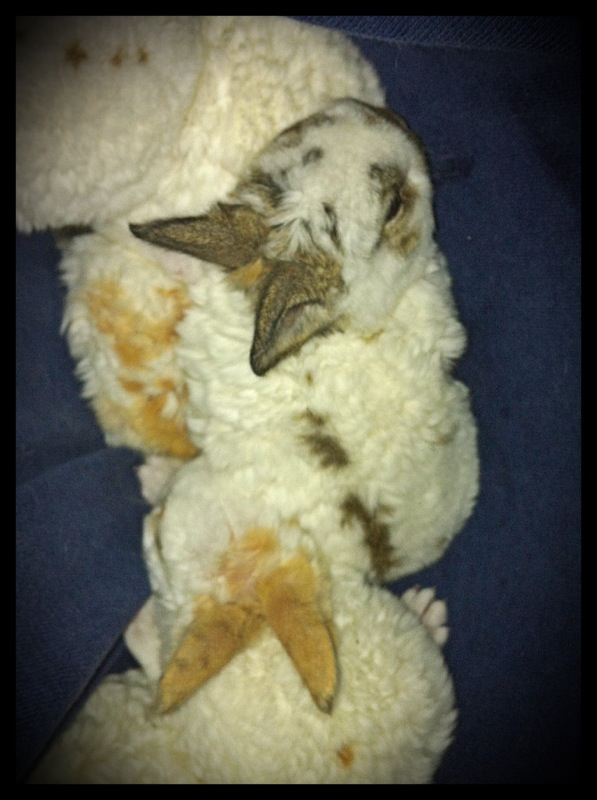
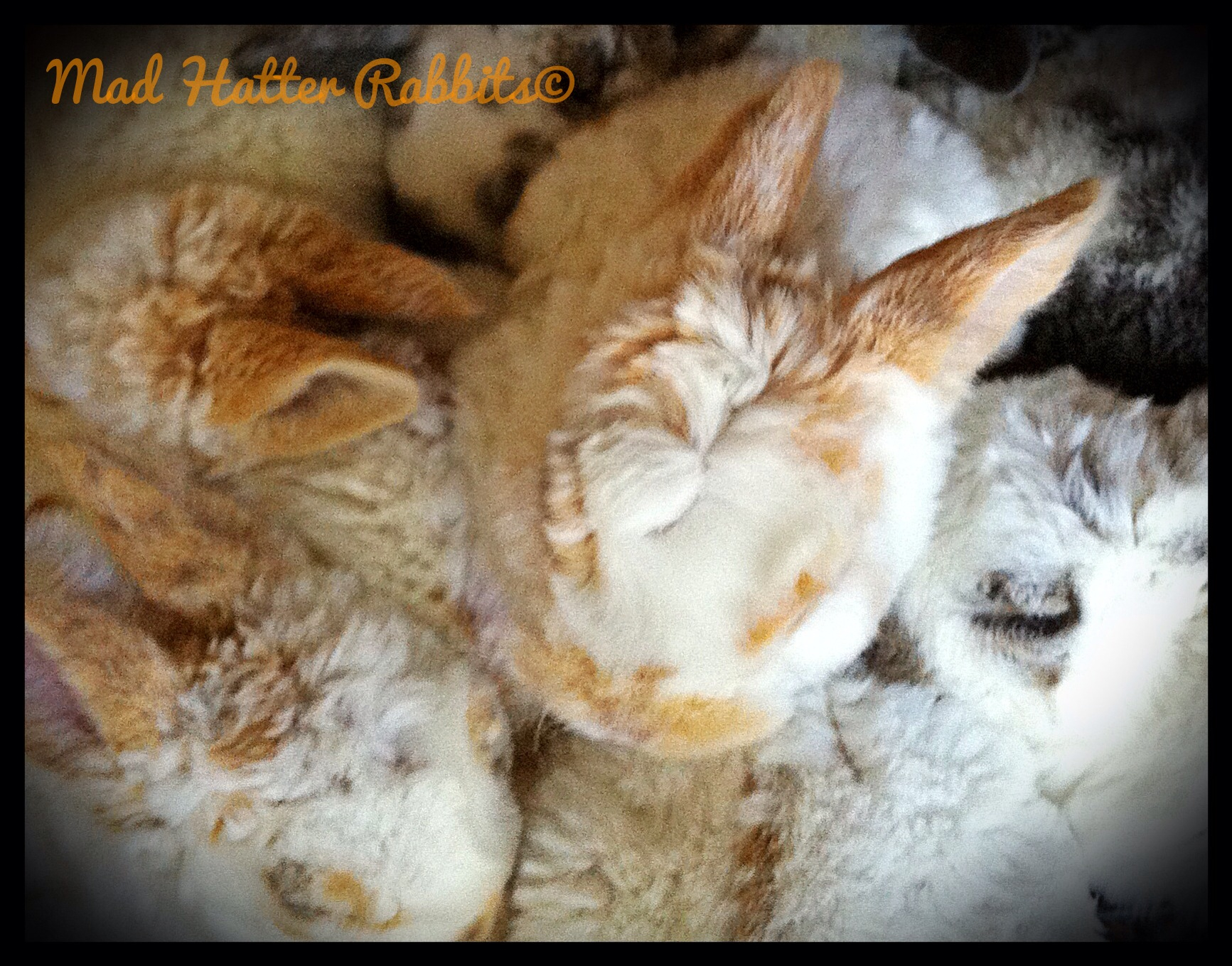
Our very first litter of mini Rex was born 19 days ago to a first-time mom, Inca and first-time dad, Bushy. They’re both broken, so the resulting litter is 100% broken coloring with many charlies as well. As they’ve developed they’ve caught my attention because their hair seemed to be… peculiar. But it’s our first purebred Rex litter so I wasn’t sure what I was seeing wasn’t… normal.

Astrex mini Rex litter, 10 days old

Astrex mini Rex litter, 10 days old

10 Days Old

Astrex Mini Rex litter, 19 Days Old

Astrex Mini Rex litter, 19 Days Old

19 Days Old

It appears this litter has gotten a full helping of the very rare Astrex gene. This fur type is not recognized by ARBA, so breeders of show rabbits who find it in their nest boxes typically cull. Also, the curl may not stick around through the baby fur and will molt out to normal… the parents of this litter are completely normal in their mini Rex fur, not a curl to be seen!

I’ve been scouring the internet for information and have discovered a few people who are breeding specifically for this trait. It can be found in several breeds besides Rex and mini Rex, also in Harlequin and New Zealand. I’m trying to learn more, so if you, or anyone you know, has found curly coated rabbits in their nestboxes, please let me know! I’ve also created a Facebook page to further discussion on this topic.


cover


Links to the other pages I’ve discovered talking about Astrex:

Astrex, Curly Coated Rabbits on Facebook

Duman’s Ark (Great Photos!)

Astrex Rabbits Curly Wavy Bunnies

Astrex Rabbits

American Astrex Rabbit Breed Club

Rabbit Due Date Calculator

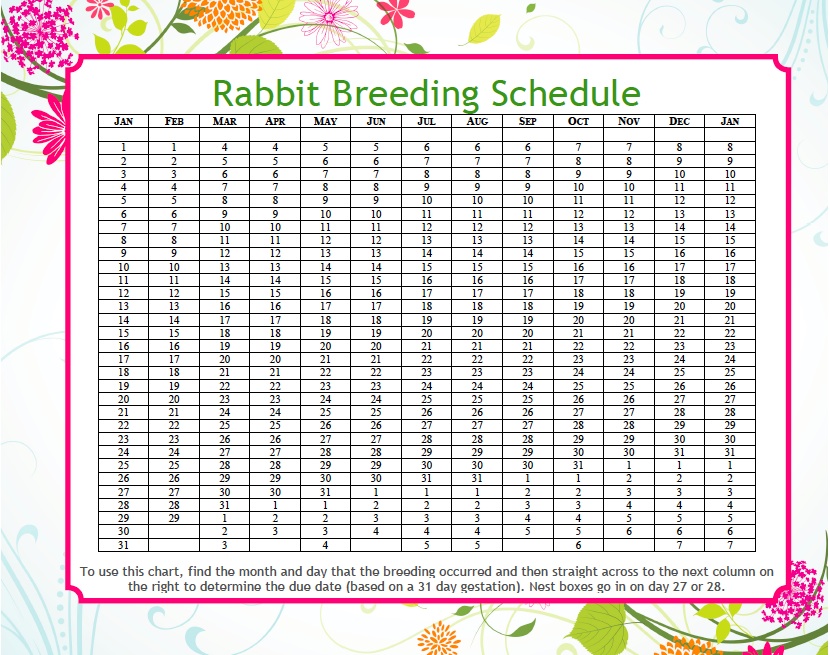
I’ve discovered it’s pretty helpful to be able to count the days of your rabbits gestation. I recently came across this tool that could be useful for you. Print it out and keep it with your records and you’ll be able to predict your rabbits due date, based on a 31 day gestation.

Just go down to the month and date your rabbit was bred, then the next number to your right is the date they are due. Easy peasy!

Easy Peasy Rabbit Breeding Schedule

Easy Peasy Rabbit Breeding Schedule

Thanks to Hannah from Aim High Photography for creating the background for this!

Games Bunnies Play

Richard Dawson hosts - Games Rabbits Play!

Richard Dawson hosts – Games Bunnies Play!

Thanks to M. Marshall for sharing this via the ARBA Facebook page!


We’re talking mind games here, folks, not binkies.

Here are a few that my bunnies like to play:

Are there Buns in my Oven? A simple guessing game that does like to play. She shows no signs of pregnancy up until the very last moment… and then when you figure she’s not pregnant after all, she presents you with a fine litter and a bunny smirk of satisfaction.

The Dead Buck Game. You go into the rabbitry and your favourite buck is flat out on his side, seemingly not breathing. No amount of calling his name or prodding seems to get a response. Just when you’re ready to go dig a hole out back, he stirs slightly, gives himself a shake and asks what’s for supper.

Nya-nya! You Can’t Make Me! A game enjoyed by all rabbits of all ages. The object is simple: drive the bunny caregiver crazy by refusing to do the simplest things. Can be applied to eating, drinking, breeding, caring for kits or any other aspect of daily bunny life.

Cold Butt aka The Great Bunny Snit. You do some small thing that offends one of your rabbits. The rabbit immediately turns his back on you and shuns you for hours or days, depending on the degree of offendedness. Half the time, you don’t even know what you did wrong.

What Sex Am I This Week? A fun little game played by youngsters. They really enjoy this one when you have a waiting list of buyers.

Escape Hatch Hurry up! “If we get all of this food eaten, we can squirrel our way out through the J-feeder! That crazy woman LOVES to play chase!!!”

Are there Buns in my Oven? Version Two. The object is to drive the bunny caregiver mad with frustration. Bunny lifts for the buck, acts pregnant for the next month getting away with all kinds of crankiness, builds a lovely nest, pulls fur… and then nothing.

How’d They Do That? To keep you guessing, they accomplish impossible things that have no explanation. A good example of this was when we found one of our youngsters roaming around the flower pots one morning. The hutch door that closes with barrel bolts was open, and all the other youngsters were leaning out of the doorway. At least in “Escape Hatch,” there is an explanation!

What Color Am I Going To Be When I Grow Up? In this game,  a black bunny decides that it needs to turn into a rabbit with tipping, or an agouti, or who knows what?!
“I am the Guru Bunny.” One of the kits sits all by itself, eyes closed, usually in a corner, while all the rest of the kits come running up to see ya when you arrive, all bouncing and acting like…well..bunnies… ..ya can almost hear the “Ohm…Ohm….”coming from that back corner.
How Many Ways Can We Waste Feed? This includes digging in the feeder, throwing hay out of the rack, pooping in the feeder….tipping bowls of treats, etc. (My response is to cut back on the amounts. If they aren’t hungry, they can afford to play with food!)


Big thank you to M. Marshall for sharing the creativity!

Rare and Heritage Breeds

Credit Devon Mary Ward / The Whimsy Dog Studio

Credit Devon Mary Ward / The Whimsy Dog Studio

As our rabbitry evolves, we find our attention shifting to those breeds classified as Rare or Heritage.


A “Rare” breed is self-explanatory. These rabbits are extremely difficult to find and in danger of extinction. The “heritage” breed classification is monitored by the American Livestock Breeds Conservatory and designates the animals were developed in the United States. These classifications make note of animals that offer something special to the rabbit world and to the United States.


We raise Silver Fox and Cinnamon rabbits and are very proud to do so. Additionally, the Champagne d’Argent is a breed that has flirted with the rare breeds list over the years, although it is very common in Europe. We love the personality of these rabbits and their usefulness as a multi-purpose animal, both cuddly, showable, and nutritious!

Classified

Carin / stock.xchng

Carin / stock.xchng

To Whom It May Concern:

I am seeking a bunny ribbit, preferably a dough that is bread or already peruvian, with legs. This dow will be the start of my heard and I would love it if she could be a loop-eared bred. Would prefer the animal to come with it’s own bowel and food for at least a moth. I am not interested in a spade do, as she will be used mostly for bredding. Am also open to a Rex, both the velveteen and regular kind, for the pellets. Please let me know if you are sailing your bunnee, as I would like to have it run free in my pastor as soon as possible.

Tank U.

(This post was inspired by the many classified listings for rabbits filled with misspellings and the humor of my fellow rabbit lovers! This is intended to be humorous, not mean-spirited!)

DID YOU ENJOY THIS POST?

SUBSCRIBE TO THE PAGE, “LIKE” MAD HATTER RABBITS ON FACEBOOK AND FOLLOW @MADHATRABBIT ON TWITTER!